
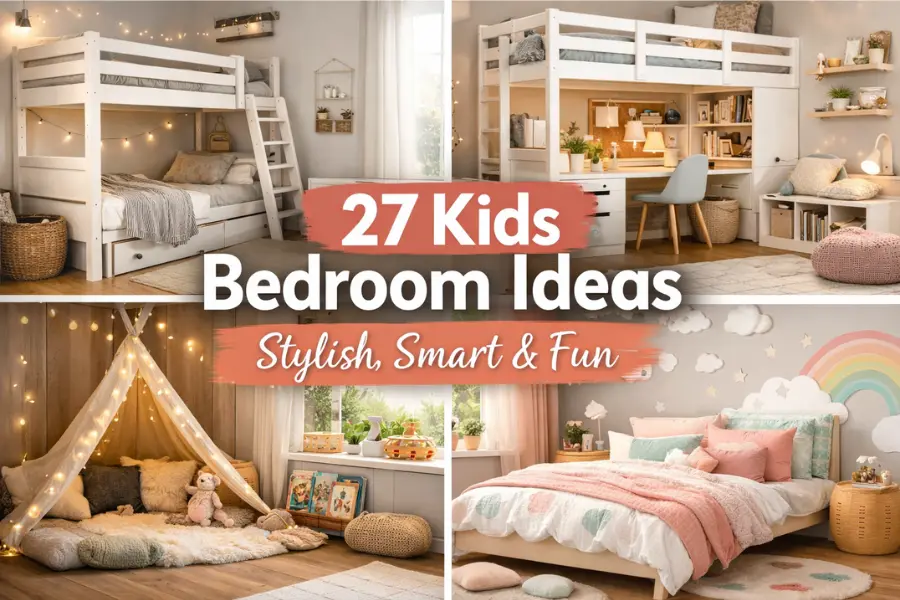
27 Kids Bedroom Ideas That Feel Stylish, Smart & Fun
A kids bedroom is so much more than just a place to sleep. It is where your child plays, learns, dreams, and grows every single day. A well-designed room supports all of that — and honestly, it makes your life easier too.
I have been working in home decoration for years, and the one thing parents always tell me is that they feel overwhelmed when it comes to their child’s bedroom. Too many options, too much furniture, and no clear direction. That is exactly why I put this guide together.
Whether you have a tiny room or a spacious one, a toddler or a ten-year-old, these 27 kids’ bedroom ideas are practical, beautiful, and completely doable at home. You do not need a huge budget or a professional designer. You just need the right plan. Let us get into it.
Table of Contents
27 Kids Bedroom Ideas
Here are the best ideas for decorating your kids bedroom:
1. Bunk Bed Space Saver Design
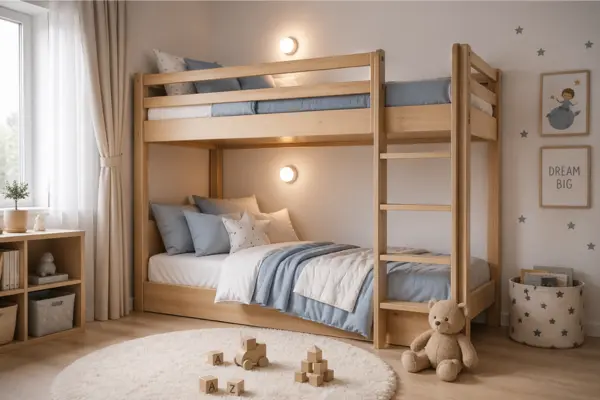
If you have two kids sharing one room — or even one kid who just loves adventure — a bunk bed is honestly one of the smartest investments you can make. It stacks two sleeping spaces vertically so your floor stays open and free for playing, storage, or a little desk setup. Kids absolutely love the top bunk, and it turns bedtime into something exciting rather than a struggle.
Why It Works
A bunk bed uses height instead of floor space. In a small or shared room, that freed-up floor area is priceless. It gives you room for play, movement, and furniture without things feeling cramped or crowded. It is a two-for-one sleeping solution that genuinely makes the room feel bigger.
Best For
Shared bedrooms with two children, or small rooms where floor space is limited. Also great for kids who love having a cozy, elevated sleeping spot.
Styling Tips
Add matching bedding sets for each bunk to keep things cohesive. Install small wall-mounted reading lights near each bed so kids can read without disturbing each other. Always use safety rails on the top bunk, and consider a ladder with wide, grippy steps. A small curtain on the lower bunk creates a private little cave that younger kids adore.
2. Loft Bed With Study Zone
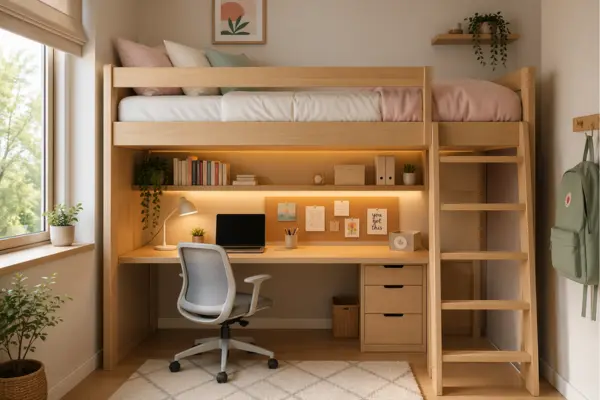
A loft bed is one of my all-time favourite ideas for kids who need both a sleeping space and a study area but do not have the square footage for both. The bed goes up top, and everything you need — a desk, shelves, storage — sits underneath. It is essentially a two-room setup inside one small room. Clever, functional, and kids think it is incredibly cool.
Why It Works
By lifting the bed off the ground, you instantly create a whole new zone underneath that would otherwise just be wasted space. It gives your child a clear separation between where they sleep and where they study, which is actually really good for focus and bedtime routine. Two functions, one footprint.
Best For
Small bedrooms, school-age children who need a proper study area, and kids who love having their own little multi-level world.
Styling Tips
Place a compact desk with a comfortable chair directly underneath. Add a small pegboard or floating shelf on the wall beside the desk for supplies and books. Use a warm LED desk lamp rather than relying on overhead lighting. Pin a small corkboard above the desk for drawings, notes, or a schedule. Keep the colour palette simple under the loft so the space feels open rather than closed in.
3. Soft Pastel Color Theme
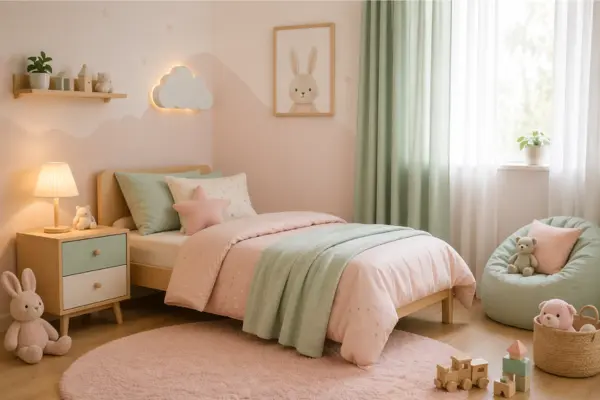
Colour has a massive impact on how a room feels — especially for children. Soft pastel tones like blush pink, powder blue, mint green, and warm beige create a calming, gentle atmosphere that helps kids unwind at the end of the day. Unlike bold or bright shades, pastels do not overstimulate. They make a room feel fresh, clean, and peaceful without being boring.
Why It Works
Soft colours reduce visual noise. When a room is too bright or too busy, it actually makes it harder for children to relax and fall asleep. Pastels hit the sweet spot — they are cheerful and welcoming without being overwhelming. They also tend to last through different ages without feeling babyish or out of place.
Best For
Toddler rooms, nurseries, and young children’s bedrooms. Also works beautifully for any age if you want a calm, light-filled space.
Styling Tips
Pick two or three pastel shades that complement each other and use them across walls, bedding, and soft furnishings. Do not match everything exactly — a little variation feels natural and intentional. Use white trim and light wood furniture to keep things airy. Add texture through knit cushions, cotton rugs, and linen curtains to give the softness some depth.
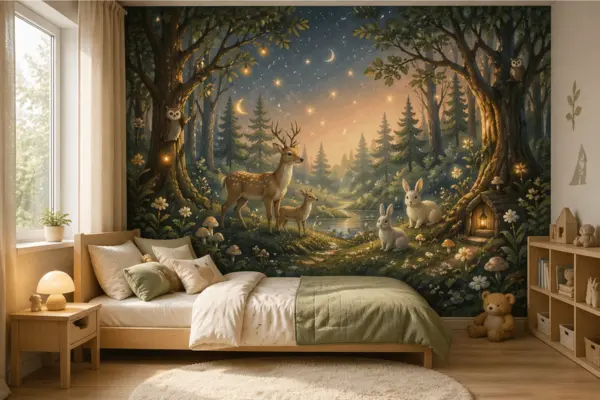
4. Wall Mural Story Design
A wall mural is one of the most impactful things you can do in a kids bedroom, and it does not have to cost a fortune. Whether it is a forest filled with animals, a galaxy full of stars, an underwater ocean scene, or rolling hills and castles — a mural turns a plain wall into a whole world. Kids interact with it, dream about it, and honestly spend more time in their room because of it.
Why It Works
A mural gives the room a strong identity and a focal point. It sparks imagination, supports creative play, and makes the space feel special and personal. It is also the kind of thing that grows with a child — they will find new things in it for years. You do not need to paint it yourself either; peel-and-stick mural wallpaper is widely available and very easy to install.
Best For
Children who love storytelling, imaginative play, or have a favourite theme like animals, space, nature, or fantasy.
Styling Tips
Apply the mural to a single feature wall — usually the wall behind the bed — so it has maximum impact without overwhelming the room. Keep the rest of the décor simple and neutral so the mural remains the star. Choose colours in the mural that you can echo in your bedding and accessories for a pulled-together look.
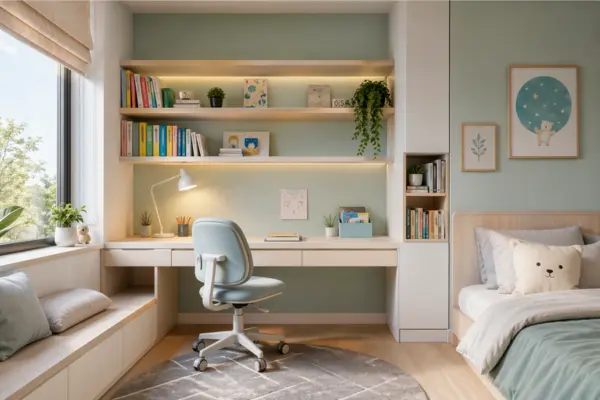
5. Built-In Study Table Setup
A dedicated study space inside the bedroom is one of the best things you can give a school-age child. When the desk is built into the room — whether fitted into a corner, alcove, or along one wall — it becomes a proper study zone rather than just a table that gets covered in toys. It signals to your child that this is where learning happens, and that routine makes a real difference to focus and homework habits.
Why It Works
Built-in study setups keep everything in one organised place. Books, stationery, notebooks — it all lives at the desk. There is no dragging bags out at the kitchen table or losing things across the house. It also avoids clutter spreading to the rest of the room, which keeps the bedroom feeling calm and tidy.
Best For
School-going children of any age, kids who do homework regularly, or children who love drawing, crafting, or building projects at a dedicated space.
Styling Tips
Add floating shelves above the desk at a comfortable reach height to store books, binders, and supplies. Use a task lamp with adjustable brightness. A small bulletin board or corkboard panel above the desk is great for pinning schedules, artwork, and reminders. Keep the desktop clear of anything that is not study-related — use drawer organisers or small boxes to keep supplies sorted.
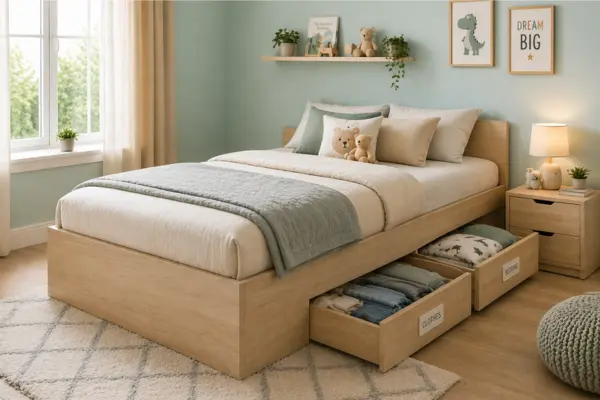
6. Storage Bed With Drawers
One of the biggest challenges in any kids bedroom is storage — because kids accumulate things fast. A storage bed solves a huge chunk of that problem elegantly. These beds have built-in drawers underneath the mattress, giving you a generous amount of hidden storage right where the floor space would otherwise be wasted. Clothes, spare bedding, soft toys, books — it all disappears neatly under the bed.
Why It Works
A storage bed essentially gives you an extra chest of drawers without taking up any additional floor space. In a small room, that is a game-changer. It keeps the bedroom looking clean and tidy because everything has a home, and it cuts down on the number of extra furniture pieces you need to buy.
Best For
Small bedrooms, rooms with limited storage, and families who want to keep clutter off surfaces and out of sight.
Styling Tips
Use labels on each drawer so kids can find things and put them back independently — this is a big win for teaching organisation. Group the contents logically: one drawer for seasonal clothes, one for extra bedding, one for toys or craft supplies. Choose a bed frame in a neutral finish that works with whatever colour scheme you have, since the storage drawers will likely stay long after you redecorate.
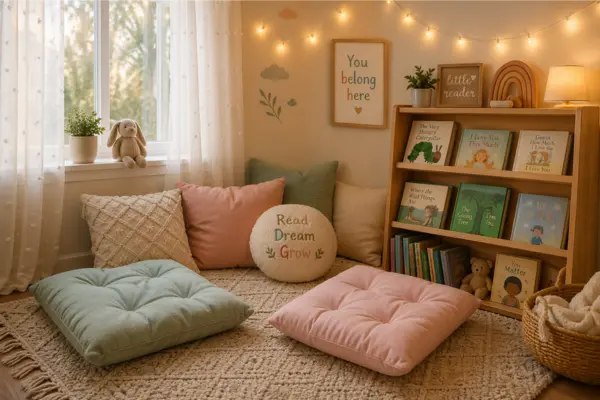
7. Reading Corner With Floor Cushions
Every child deserves a cosy spot just for reading, and you honestly do not need much to create one. A corner of the room, a couple of large floor cushions, a small bookshelf nearby, and a warm light source — that is all it takes. Reading corners are magical little spaces that invite children in and make books feel exciting. And the best part? They are easy to set up on any budget.
Why It Works
Having a physical space dedicated to reading helps build the habit. When a child has their own comfortable nook, they are far more likely to pick up a book than if they are just lying on a bed or sitting at a desk. It also gives the room a quiet zone, which is useful for winding down before sleep or taking a break from more active play.
Best For
Book-loving kids, children who need a calm retreat, and any room that has a small corner available — even the tiniest nook can work beautifully.
Styling Tips
Layer floor cushions and a couple of throw pillows in soft, textured fabrics. Add a small low bookshelf or a wall-mounted book ledge so titles are visible and accessible — kids are far more likely to read a book they can see the cover of. String fairy lights or use a small floor lamp for warm, cosy lighting. A soft rug underneath ties the corner together and defines the space clearly.
8. Shared Room Divider Setup
When two kids share a bedroom, giving each of them their own defined territory makes a world of difference. A room divider does not need to be a solid wall — in fact, it works best when it is something that divides without completely closing off the space. Bookshelves, curtain panels, a low storage unit, or even a decorative screen can all create that sense of personal space without making the room feel smaller.
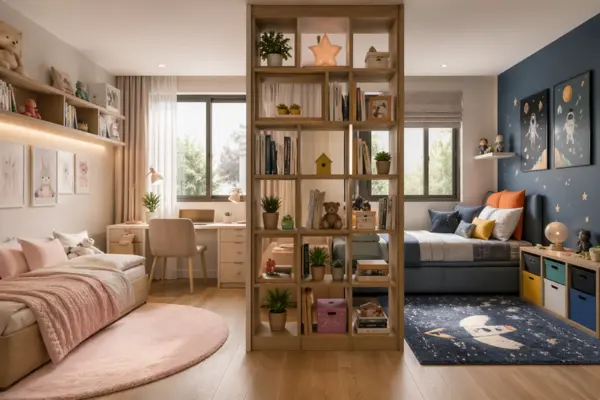
Why It Works
Children who share a room are happier when they each have a sense of ownership over their corner. It reduces conflict, gives each child privacy for reading or quiet time, and allows siblings to personalise their own side with their favourite colours, posters, or décor. It is a simple change that has a big impact on how well shared rooms actually function.
Best For
Siblings sharing one bedroom, children of different ages or genders who need separate zones, or any shared room where conflict over space is becoming an issue.
Styling Tips
A double-sided bookshelf is one of the most practical dividers because it gives storage to both sides while acting as a visual boundary. Curtains hung from a ceiling track are a flexible option that can be opened or closed as needed. Let each child personalise their own side of the divider with their own artwork, lighting, or colour accents so it truly feels like two separate spaces within one room.
9. Chalkboard Wall for Creativity
A chalkboard wall is one of those ideas that sounds simple but completely transforms a room. You paint one section of the wall with chalkboard paint — a product you can find in any paint shop for very little money — and suddenly your child has an entire wall to draw on, write on, practise letters, play games, and express themselves freely. It is endlessly wipeable and endlessly reusable.
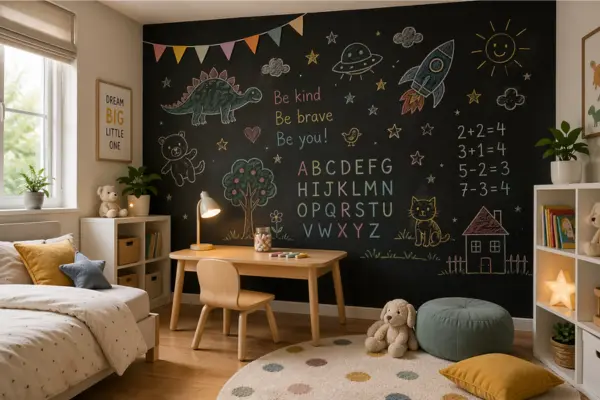
Why It Works
It channels creative energy in a constructive and clean way. Instead of drawing on walls, furniture, or endless sheets of paper, children have one big dedicated surface for expression. It also doubles as an educational tool — parents and kids can use it for spelling, maths, drawing, or just leaving each other little messages. It encourages daily creativity without any effort or ongoing cost.
Best For
Creative and artistic children, younger kids who are learning to write and draw, or any room where you want to add an interactive, playful feature without spending much money.
Styling Tips
Paint the chalkboard wall in the play area or near the study desk rather than directly behind the bed. Add a small tray or a wall-mounted chalk holder nearby so supplies are always within reach. Frame the chalkboard section with a simple painted border or a thin wooden frame to give it a finished, intentional look rather than a painted accident.
10. Theme-Based Bedroom Design
A themed bedroom is genuinely exciting for children because it turns their room into a place that feels like it was made just for them. Space explorers, jungle adventurers, ocean divers, race car drivers, fairy tale princesses — whatever your child is passionate about can become the heartbeat of the room. Done well, a themed room is immersive and fun without being over-the-top or hard to update later.
Why It Works
A strong theme gives the room a clear identity that resonates emotionally with your child. It makes the room feel intentional and personal, which means kids are more attached to it — they want to spend time there, keep it tidy, and show it off to friends. Themes also make decorating decisions easier because everything filters through one clear vision.
Best For
Younger children and toddlers who are deeply into a particular interest, or any child who wants a room that reflects their personality rather than a generic design.
Styling Tips
The smart way to do a themed room is to keep the large furniture pieces neutral — white or natural wood beds, desks, and wardrobes — and bring the theme in through the details. Bedding, wall art, a mural, curtain fabric, rugs, and accessories carry the theme without locking you into an expensive overhaul when your child’s interests inevitably change. This approach lets you refresh the theme cheaply as they grow.
11. Floating Wall Shelves
Wall shelves are one of the most underused tools in kids bedroom design, and I genuinely cannot recommend them enough. They move storage off the floor and onto the walls, which instantly makes a room feel bigger and more open. Books, toys, plants, art supplies, decorative objects — all of it can live beautifully on well-placed shelves without taking up a centimetre of floor space.
Why It Works
Floor space in a kids room is precious. The more you can move storage vertically, the more room there is for movement, play, and large furniture pieces. Floating shelves are also incredibly versatile — they can be arranged in straight rows, staggered patterns, or interesting geometric layouts to add character to the walls as well as function.
Best For
Rooms of any size, but especially useful in small and medium bedrooms where every square metre of floor space counts.
Styling Tips
Install the lowest shelves at a height your child can actually reach — making storage accessible encourages kids to put things back independently. Arrange books with the covers facing outward on lower shelves to make reading more inviting. Mix in a few small decorative items alongside the practical stuff to keep shelves looking intentional rather than just functional. Group things in odd numbers — threes and fives always look better than twos and fours.
12. Indoor Play Tent Corner
A play tent inside a bedroom creates an instant sense of magic. It is a soft, enclosed little world that belongs entirely to the child — a place to read, pretend, rest, or simply hide away for a while. Play tents come in dozens of styles, from simple cotton canopies to fully structured tipi tents, and most are affordable, easy to set up, and easy to move.
Why It Works
Children have a natural instinct to seek out small, enclosed spaces — it is called the “hut instinct,” and it is completely normal. A play tent satisfies that need in a safe, beautiful way. It gives them a sense of privacy and autonomy inside a shared family home, which is really important for their independence and self-regulation. It also adds a strong visual focal point to the room.
Best For
Toddlers and young children who love imaginative play, cosy spaces, and having somewhere that feels exclusively theirs.
Styling Tips
Place the tent in a corner or beside the bed so it feels tucked away and sheltered rather than just parked in the middle of the room. Fill the inside with soft cushions, a small blanket, and a few favourite books or toys. Add a string of warm fairy lights around or inside the tent for a magical, glowing effect. Choose a tent in a neutral fabric like natural cotton or linen so it does not clash with the rest of the room’s colour scheme.
13. Under-Bed Storage Boxes
The space under a standard bed is one of the most wasted areas in any kids bedroom. Sliding storage boxes under the bed transforms that dead space into a practical, accessible home for toys, spare clothes, craft supplies, or anything else that would otherwise pile up on surfaces or in corners. It is a zero-footprint storage solution, and it works brilliantly.
Why It Works
You are using space that already exists without adding any extra furniture to the room. Under-bed storage is especially powerful in small bedrooms where there is simply no wall space left for more shelving or wardrobes. It also keeps things hidden and out of sight, which makes the room look immediately tidier without you having to actually organise everything perfectly.
Best For
Small bedrooms with limited storage options, rooms that tend to get cluttered quickly, or any child who has more stuff than the current storage can handle.
Styling Tips
Use matching boxes or baskets so the under-bed area looks cohesive if it is ever visible. Flat, wheeled storage containers are the most practical because they slide in and out easily — kids can access them independently. Label each box clearly with words or pictures so children know exactly where things live and can put them back without your help. Keep seasonal or less-used items in the harder-to-reach boxes at the back.
14. Bright Accent Wall
A single bold, bright wall can completely transform the energy of a kids bedroom without overwhelming the whole space. An accent wall is one wall painted or papered in a stronger colour or pattern while the remaining three walls stay neutral. It creates a visual anchor for the room, adds personality and playfulness, and is one of the easiest and most affordable ways to make a big impact.
Why It Works
An accent wall adds energy and colour without making the whole room feel heavy or closed in. Because only one wall carries the bold colour, the room stays balanced and light. It also gives you a natural focal point — usually the wall behind the bed — which makes the whole layout feel more intentional and designed rather than random.
Best For
Modern and playful room styles, children who love colour, or parents who want to add personality to a room without committing to a full colour scheme change.
Styling Tips
Cheerful, energetic shades like sunshine yellow, sky blue, grass green, or warm terracotta all work beautifully as accent walls in kids rooms. Match the tone of the accent colour to your child’s personality — energetic kids often love bright, saturated shades while gentler, more introverted children might prefer a deeper, moodier tone. Balance the accent wall with neutral bedding, natural wood furniture, and simple accessories so the wall pops without competing with everything else.
15. Scandinavian Style Kids Room
Scandinavian design is one of the most popular interior styles in the world right now, and it works especially well in children’s bedrooms. The approach is built around light, simplicity, and quality — light wood furniture, white walls, soft natural textures, and just a few carefully chosen accessories. The result is a room that feels calm, clean, and effortlessly beautiful without trying too hard.
Why It Works
The minimalist nature of Scandinavian design means there is less visual clutter, which makes a room easier for both children and parents to maintain. Everything has a place and a purpose. The neutral palette also makes it incredibly easy to update the room as your child grows — you swap out a few accessories and it feels completely fresh without any major work.
Best For
Families who prefer a minimal, modern aesthetic, parents who want a room that looks stylish without constant upkeep, and any room size — Scandinavian design works particularly well in smaller spaces.
Styling Tips
Stick to a palette of white, soft grey, and natural wood tones as your base. Add warmth through textures — a chunky knit blanket, a sheepskin rug, linen curtains, and cotton cushions all add softness to what could otherwise feel cold or clinical. Bring in one or two accent colours through cushions or artwork — muted shades like dusty rose, sage green, or warm mustard work best. Keep surfaces clear and let the few decorative pieces you choose really count.
16. Hanging Swing Chair
A hanging swing chair in a kids bedroom is one of those design choices that people always comment on — and children absolutely live in it. It adds a playful, slightly unexpected element to the room while also providing a genuinely comfortable spot for reading, relaxing, or just sitting and spinning for a while. It is functional furniture that also looks incredibly stylish.
Why It Works
A swing chair combines movement and relaxation in a way that regular furniture simply cannot. For many children — especially those who find it hard to sit still — gentle swinging motion is actually calming and helps them focus or wind down. It also gives the room a visual centrepiece that is more interesting than a standard armchair or beanbag.
Best For
Spacious bedrooms that have enough ceiling clearance and open floor space to accommodate a hanging chair safely. Also wonderful for older children and teens who want a special reading or relaxation spot.
Styling Tips
Always install a hanging chair with a professional-grade ceiling hook anchored into a joist — never into drywall alone. Place it near a window if possible so your child gets natural light while reading. Choose a chair in a neutral rattan, cotton, or rope style so it blends with the overall décor rather than dominating it. Add a soft cushion inside for extra comfort, and hang it at a height that allows easy, safe entry and exit.
17. Personalized Name Wall Decor
Putting your child’s name on their bedroom wall is one of the simplest and most effective ways to make the room feel truly theirs. It does not matter whether you use wooden letters, a neon LED sign, a framed print, or a hand-lettered piece of art — having their name in the room creates an immediate sense of ownership and belonging that children respond to in a really beautiful way.
Why It Works
Personalisation builds emotional connection. When a child sees their name on the wall, it signals that this space was created for them specifically — not just a generic room they happen to sleep in. It also makes the room feel finished and complete in a way that no amount of furniture quite achieves on its own.
Best For
Children of all ages, from babies right through to teenagers — the style of the name display just evolves as they grow. It is also a wonderful choice for nurseries as a first personalisation element.
Styling Tips
For younger children, go for wooden block letters painted in soft colours or natural wood tones — they are tactile, safe, and charming. For older children, consider a simple neon LED sign in their favourite colour, a clean typography print in a nice frame, or large metal letters. Position the name above the bed, above the desk, or on the main feature wall. Choose a font and finish that feels consistent with the rest of the room’s style rather than something that clashes with your overall palette.
18. Adjustable Furniture Setup
Children grow faster than anyone ever warns you about. The furniture that works perfectly for a five-year-old often feels completely wrong by the time they are nine. Investing in adjustable furniture — pieces that can change height, configuration, or function as your child develops — means you get far more years of use out of each piece without constantly buying new things.
Why It Works
Adjustable furniture adapts to your child’s changing needs rather than needing replacement every few years. Height-adjustable desks and chairs support healthy posture as a child grows taller. Convertible cribs that become toddler beds and then full-size beds are a classic example. This approach saves money in the long run and also reduces the waste and disruption of constant room overhauls.
Best For
Long-term room planning, families who prefer to invest in quality pieces once rather than replacing things frequently, and parents who want a room that evolves with their child without constant redecorating.
Styling Tips
When shopping for adjustable pieces, prioritise simple, clean designs over trendy styles — a piece that is too style-specific will look dated faster than a classic neutral one. Look for solid wood or high-quality engineered wood, which handles adjustments and years of use far better than cheap flat-pack materials. Pair adjustable furniture with easily swappable décor elements — bedding, cushions, wall art — so you can refresh the room’s look as your child ages without replacing the core furniture.
19. Star Ceiling Lights
Few things make a kids bedroom feel more magical at night than looking up at a ceiling full of softly glowing stars. Star ceiling lights — whether achieved through a projector, stick-on glow stars, or a fibre optic light panel — create a dreamy, immersive atmosphere at bedtime that helps children feel calm, secure, and ready for sleep. It is an affordable idea with an outsized impact on the feel of the room.
Why It Works
Soft, dim light before sleep is actually much better for children’s sleep quality than bright overhead lighting. Star lights provide just enough gentle illumination to feel comforting without being stimulating. Many children who resist bedtime become far more cooperative when they have something magical to look forward to — lying under their own personal night sky every evening.
Best For
Younger children and toddlers who are anxious about the dark, or any child who would benefit from a more soothing, relaxed bedtime experience.
Styling Tips
A ceiling projector is the most flexible and impressive option — look for one that projects stars and slowly rotates for a full galaxy effect. Stick-on glow-in-the-dark stars are the simplest and most affordable approach, though they require charging with light. For a more permanent and beautiful solution, a fibre optic star ceiling panel can be fitted by an electrician and looks truly stunning. Always choose warm white or soft amber tones rather than cool blue or white light, which is more energising than relaxing.
20. Toy Storage Baskets
Toy storage baskets are one of the most practical things in a well-organised kids bedroom, and also one of the easiest to implement immediately. A set of well-chosen baskets on low shelves or stacked in a corner gives toys a clear, accessible home — which means tidying up takes minutes rather than a battle of wills. Children can see what they have, reach what they want, and put things back without any help.
Why It Works
When storage is visible, accessible, and simple to use, children actually use it. Baskets are far easier for small hands than drawers with fiddly handles or boxes with tight-fitting lids. They also look attractive when grouped together — a row of matching baskets on a low shelf looks intentional and tidy rather than chaotic, even when they are filled with an enormous collection of toys.
Best For
Daily toy storage in rooms used by toddlers and young children, any room where loose toys are a constant tidying challenge, or parents who want a storage solution that children can manage independently.
Styling Tips
Use soft fabric baskets or woven cotton rope baskets rather than plastic bins — they look much better and are gentle on little hands. Stick to two or three colours or materials across your baskets so the storage area looks cohesive rather than mismatched. Add picture labels to each basket so that pre-readers can identify what goes where and tidying up becomes a genuinely independent activity rather than a guided one.
21. Multi-Zone Layout Design
Dividing a kids bedroom into clear zones — one for sleeping, one for studying, one for playing — is one of the most effective design strategies I recommend to parents. When a room has distinct areas for different activities, children instinctively understand what each zone is for. They sleep in the sleep zone. They study in the study zone. They play in the play zone. This structure supports better habits and a calmer daily routine.
Why It Works
A multi-zone layout eliminates the confusion that comes from a room where everything happens in one undifferentiated space. When the bed is surrounded by toys, children struggle to wind down at bedtime. When the desk is next to the TV, studying is a constant fight against distraction. Zones create mental and physical cues that guide behaviour naturally, which makes the whole daily routine — from morning to bedtime — run more smoothly.
Best For
Medium to large bedrooms where there is enough floor space to create genuinely separate areas, children who have trouble transitioning between activities, or families who want to support better sleep, study, and play habits.
Styling Tips
Use rugs to define each zone clearly — a play rug in the centre of the room, a smaller rug under the desk, and a soft bedside rug near the bed all signal different purposes without needing walls or dividers. Keep lighting zone-specific too: bright task lighting over the desk, warm ambient light in the play area, and a gentle dim lamp by the bed. Arrange furniture so the zones feel natural and intuitive rather than forced.
22. Window Reading Bench
A window seat is one of those features that every child loves and every parent wishes they had thought of sooner. A bench built under or beside a window creates a beautifully lit, naturally cosy reading spot that uses a part of the room that often just collects clutter. Add a cushion on top and you have the most inviting seat in the house.
Why It Works
Natural light is the best possible reading light, and a window seat puts your child right in the path of it. It also uses a transition zone — the area immediately around a window — that often goes to waste in a standard room layout. A well-cushioned window bench is also a gentle storage opportunity: a hinged seat can hide blankets, books, or seasonal items inside the base.
Best For
Rooms that have a low window or bay window with sufficient sill width, children who love to read and need a dedicated quiet spot with good light.
Styling Tips
Use a thick, firm cushion covered in a durable fabric — children will sit on it, kneel on it, and lie across it, so durability matters more than delicacy here. Add two or three throw cushions for back support. Hang simple, light curtains that can be pulled back fully during the day to maximise the light. If space allows, add a small built-in bookshelf on either side of the window to keep reading material right at hand.
23. Colorful Rug Play Area
A rug does a lot more work in a kids bedroom than most people give it credit for. In the play area specifically, a large, colourful rug defines the space, adds softness and warmth to hard floors, provides a comfortable surface for sitting and playing, and brings personality and pattern to the room all at once. It is one of the most affordable and highest-impact changes you can make.
Why It Works
A rug creates a clear, dedicated zone for floor play without any structural changes to the room. Children instinctively gather on a rug — it signals a comfortable, defined space for activity. Practically, it also protects floors, reduces noise, and prevents toys from sliding around on hard surfaces. A well-chosen rug can be the starting point for an entire colour scheme.
Best For
Rooms with hard flooring where comfortable floor play is important, any room that needs a focal point or a more defined play area, and toddler or young children who spend a lot of time playing on the floor.
Styling Tips
For younger children, look for rugs with built-in play features — road maps, alphabet grids, world maps, or nature scenes are endlessly engaging and educational. For older children, a bold geometric pattern or a rug in their favourite colour works beautifully. Size matters: go bigger than you think you need. A rug that is too small looks awkward and does not do the job of defining the space properly. Choose a low-pile, easy-to-clean option in a kids room — things will get spilled on it.
24. Wall Pegboard Storage
A pegboard on the wall is one of the most clever, flexible, and genuinely useful storage ideas for a kids room — particularly in the study or craft area. You mount a perforated board to the wall and then use hooks, shelves, baskets, and clips to organise everything from scissors and pencils to headphones and small toys. Everything is visible, accessible, and completely customisable.
Why It Works
The beauty of a pegboard is that it adapts to exactly what you need to store, and those needs can change without any drilling or structural changes to the wall. You simply move the hooks and shelves around. It keeps small items visible so nothing gets lost at the bottom of a drawer, and it turns a functional storage wall into something that actually looks quite stylish and intentional.
Best For
Study areas, craft corners, or any part of the room where small supplies and accessories need to be organised and within easy reach. Particularly useful for children who are visually organised and like to see their things rather than hide them in drawers.
Styling Tips
Paint the pegboard in a colour that complements your room’s palette — a pale blue, warm white, or sage green pegboard looks far better than the standard raw wood or black. Use a mix of hooks in different sizes, a small shelf bracket or two, and a few small wire baskets to create a varied, layered look. Keep the items you hang on it genuinely organised — a chaotic pegboard defeats the purpose entirely. Arrange by category: art supplies together, stationery together, accessories together.
25. Double Desk Setup for Siblings
When two children share a bedroom and both need a study space, a double desk setup is the most practical and space-efficient solution available. Rather than squeezing two separate desks into a room that is already busy, a single long desk along one wall gives both children a generous workspace while keeping the overall footprint compact. It is collaborative without being cramped.
Why It Works
A shared desk along a wall uses space far more efficiently than two separate desks placed elsewhere in the room. It also creates a side-by-side study dynamic where siblings can work independently but still feel connected — which is actually quite a positive experience for many children. A single desk unit is also easier to decorate and style cohesively than two separate pieces.
Best For
Siblings sharing one bedroom who both need dedicated study space, or two children who attend the same school and benefit from studying in the same environment.
Styling Tips
Create a clear visual divide between the two sides even on a shared desk — different coloured desk accessories, a small plant or lamp in the middle as a natural divider, or two different organisers on each side signal personal ownership of each half. Give each child their own set of storage: separate drawers, individual pencil cups, their own pinboard section directly above their side of the desk. This prevents arguments over supplies and gives each child a sense of their own dedicated territory.
26. Nature-Inspired Green Room
Bringing elements of the natural world into a kids bedroom creates one of the most calming and beautiful spaces I know. A nature-inspired room uses greens, browns, warm creams, and natural textures — wood, rattan, cotton, linen — alongside actual plants and botanical artwork to recreate the feeling of being outdoors. It is a style that feels fresh, serene, and genuinely timeless.
Why It Works
Research consistently shows that exposure to natural colours and materials reduces stress and improves mood — even in a bedroom setting. For children, a nature-inspired room provides a visually interesting, multi-textured environment that supports calm behaviour and healthy sleep. It also ages beautifully — a natural, organic palette rarely looks dated the way trend-driven colour schemes do.
Best For
Families who prefer a calm, organic aesthetic, children who spend time in nature and respond well to that environment, or parents who want a bedroom that feels both stylish and genuinely peaceful.
Styling Tips
Start with a base of soft white or warm cream walls. Bring in green through bedding, cushions, a feature wall painted in a muted sage or olive tone, or botanical wallpaper. Add natural wood furniture — even just a wood-framed bed or a wooden bookshelf makes a significant difference. Introduce actual plants: a small pothos or rubber plant on a shelf is beautiful, hardy, and genuinely improves air quality. Use rattan baskets, cotton rugs in earthy tones, and linen curtains to layer texture throughout the room.
27. LED Strip Lighting Design
LED strip lighting is one of the most affordable and versatile ways to add a modern, stylish glow to a kids bedroom. These flexible light strips can be fitted under bed frames, along the edges of shelves, behind a headboard, or beneath a floating desk to create soft ambient lighting that looks impressive and feels warm. The effect is sophisticated enough for older children but cosy enough for younger ones too.
Why It Works
LED strip lights create indirect, ambient lighting that makes a room feel layered and atmospheric rather than relying solely on a single overhead light source. Good lighting design is one of the things that separates a thoughtfully designed bedroom from a basic one, and LED strips allow you to achieve that layered effect very affordably. They also double as a gentle night light — left on a very low setting, they provide enough soft glow for children who prefer not to sleep in complete darkness.
Best For
Modern styled rooms, older children and teens who want a bedroom with a more grown-up feel, and any room where the lighting currently feels flat or uninspiring.
Styling Tips
Always opt for warm white (2700K–3000K) or soft amber LED strips rather than cool blue or bright white — warm light is far more relaxing and better suited to a bedroom environment. Fit them in locations where the strip itself is hidden and only the glow is visible: under the bed frame, behind a headboard panel, or along the underside of a floating shelf. Add a simple dimmer switch or choose LED strips with a remote control so the brightness can be adjusted easily for different times of day.
Mistakes to Avoid
Even the best intentions can lead to a kids bedroom that does not quite work. Here are the most common mistakes I see, and how to avoid them.
Overcrowding with furniture. This is the number one issue I encounter. Parents want to fit everything in and end up with a room that feels like a furniture showroom. Children need open floor space to play, move, and feel comfortable. If a room is too full, it creates stress rather than joy. Choose fewer, better pieces over many mediocre ones.
Using very bright colours throughout. A pop of bold colour is wonderful. An entire room painted in multiple saturated shades is overstimulating. Too much visual noise makes it harder for children to relax and sleep. Balance bold choices with plenty of neutral and soft tones.
Ignoring storage from the start. Storage is not an afterthought — it should be part of the design plan from day one. Without enough organised storage, a kids room becomes impossible to maintain no matter how beautiful it initially looks. Build in as much storage as possible and then organise it thoughtfully.
Choosing furniture that is not child-appropriate. Sharp corners, unstable pieces, and heavy items that are not anchored to the wall are real safety hazards. Always check furniture for sharp edges, ensure anything tall is wall-fixed, and make sure the scale of each piece suits the size of your child.
Designing only for right now. Children grow and change incredibly quickly. A room that is perfectly suited to a three-year-old may feel completely wrong at six. Design with flexibility in mind — invest in quality neutral furniture that will last and keep trend-specific touches in easily swappable elements like bedding, rugs, and wall art.
Forgetting about floor space. Clean, open floor space in a kids bedroom is not wasted space — it is play space. Protect it fiercely. Keep furniture to the perimeter where possible and leave the centre of the room as open as you can manage.
Conclusion
A great kids bedroom does not require a large budget or a complete renovation. It requires thoughtful planning, the right furniture choices, and a clear understanding of how your child actually lives in that space — how they sleep, study, and play.
The ideas in this guide work because they are practical first and beautiful second. They solve real problems — too much clutter, not enough space, no clear study area, siblings competing for territory — with solutions that also look great.
Start with the ideas that address your biggest current challenge. If storage is the problem, try a storage bed and under-bed boxes. If the room feels chaotic, introduce zones with rugs. If your child does not enjoy reading, create a cosy reading corner. Small, targeted changes are more effective than trying to do everything at once.
Design this room with your child involved wherever possible. Ask them what they love, what they need, and what makes them feel comfortable. The best kids bedroom is one that genuinely supports and reflects the child who lives in it.
FAQs
What is the best colour for a kids bedroom? Soft, calm colours are almost always the best starting point. Pastel shades like powder blue, mint green, blush pink, and warm beige create a peaceful environment that supports good sleep and calm moods. They are also very easy to work with because they coordinate with almost any furniture and accent colour. Save bold or bright colours for a single accent wall rather than the entire room.
How do I make a small kids room look bigger? The most effective strategies are: use a loft or bunk bed to free up floor space, mount storage on walls rather than using floor-standing furniture, keep the colour palette light and neutral, use mirrors strategically to reflect light, and protect the floor area by choosing furniture that sits against the walls rather than in the middle of the room. Maximising natural light also makes a significant difference to how spacious a room feels.
What type of bed is best for kids? The best bed depends on the room size and the child’s situation. For small rooms or siblings sharing, bunk beds are the most space-efficient option. For a child who needs a study space, a loft bed with a desk underneath is hard to beat. For any room where storage is tight, a bed with built-in drawers solves two problems at once. For long-term value, an adjustable bed frame that grows with the child is the smartest investment.
How can I organise toys in a kids room? The most effective toy organisation systems are simple enough for children to use independently. Soft fabric baskets on low open shelves work brilliantly for everyday toys. Under-bed storage boxes handle the overflow. A pegboard in the play or craft area keeps smaller items visible and accessible. Label everything with pictures as well as words so younger children can identify where things belong. The key is to give every category of toy a specific, consistent home.
How do I make a kids room more fun without making it look chaotic? The secret is to bring personality in through the details rather than the structure. Keep the large furniture pieces neutral and simple, then layer in the fun through bedding, wall art, a mural, a play tent, colourful rugs, and personalised name décor. This approach gives you a room that is playful and full of character without feeling overwhelming or difficult to maintain. It also makes updating the room as your child grows much easier and less expensive.