
24 White Living Room Ideas That Actually Work (And Look Amazing)
White living rooms never go out of style — and honestly, once you get one right, you’ll understand why designers keep coming back to this color over and over again. But here’s the thing most people get wrong: they think a white living room just means white walls and a white sofa. Then they wonder why it looks cold, boring, or like a hospital waiting room.
A truly beautiful white living room is all about layers. It’s about texture, warmth, the right accents, and knowing how to make white feel alive instead of flat. Done well, white makes a small room feel twice its size, makes natural light bounce around like magic, and gives you a space that feels fresh every single day.
I’ve put together 24 genuinely different white living room ideas — from tiny apartments to grand open-plan spaces, from budget-friendly Scandi style to full-on luxury. Each one is realistic, achievable, and designed to help you figure out what actually works for your home.
Table of Contents
24 White Living Room Ideas: The Complete Guide
Here are the best ideas:
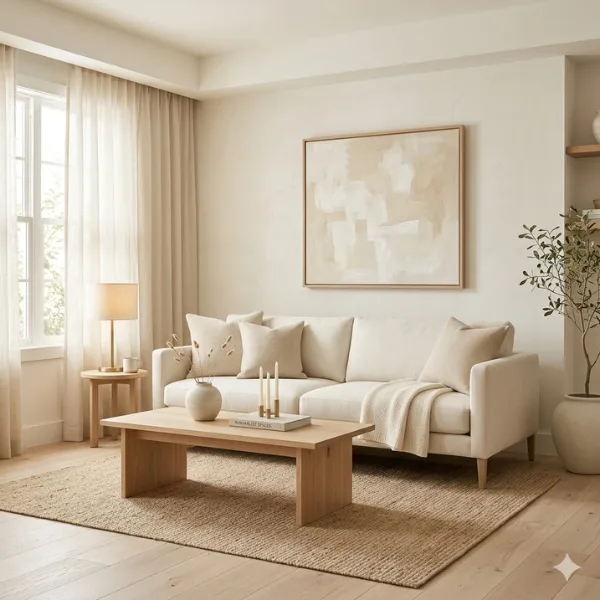
1. The Warm Ivory Minimalist Retreat
If you’ve always loved the idea of a minimalist living room but worried it would feel cold and unwelcoming, this is the idea for you. The warm ivory minimalist retreat uses soft white tones with slight yellow or beige undertones — never stark, never harsh — to create a space that feels clean and calm without being sterile. It’s the kind of room that makes you exhale the moment you walk in.
Why It Works
Pure white can feel clinical in rooms with limited natural light. Warm ivory tones, like Benjamin Moore’s White Dove or Sherwin-Williams Alabaster, bounce a golden, soft light around the room instead. Combined with minimal furniture and very intentional decor, you get a space that feels luxurious without being cluttered. The warmth in the white does all the heavy lifting, so your room never tips into that “empty rental apartment” look.
Best For
Small to medium-sized living rooms. Apartments or homes with north-facing windows that don’t get a lot of direct sunlight. Anyone who wants a clean, tidy space without it feeling cold or stark.
Styling Tips
- Pick one warm-toned white paint and stick to it on all four walls and the ceiling. Consistency is everything here.
- Choose a low-profile sofa in cream or warm linen — nothing too bulky.
- Add a single natural fiber rug like jute or sisal to ground the space.
- Keep decor to a bare minimum: one ceramic vase, one candle cluster, and one piece of simple artwork.
- Skip metals entirely or add only brushed brass in very small doses (like a single lamp base).
2. Scandi-White Hygge Haven
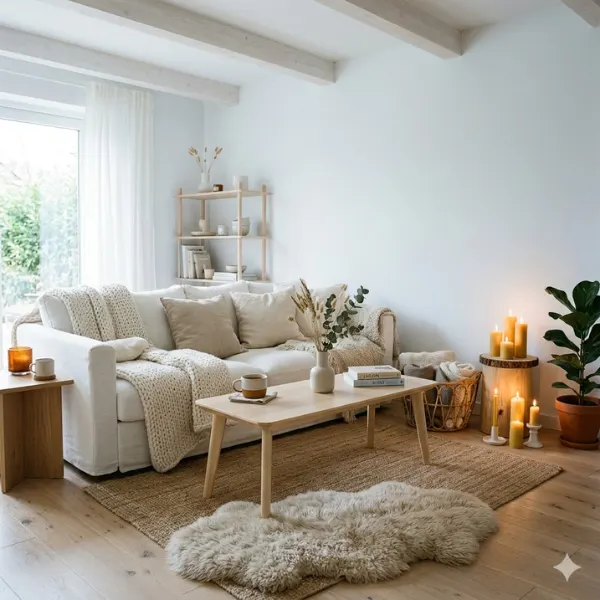
Scandinavian design has been popular for years and for good reason — it takes white and makes it feel like the coziest place on earth. The Scandi-white hygge haven is all about combining a bright white base with natural wood, soft textiles, and that warm Danish concept of “hygge” (pronounced hoo-gah) — basically, the feeling of cozy contentment. Picture fluffy knit throws, candles everywhere, and a sofa you genuinely never want to leave.
Why It Works
The Scandinavian approach understands that white on its own needs warmth to survive. By pairing crisp white walls with light birch or ash wood furniture, chunky knit textiles, and soft layered rugs, you get a room that feels bright in summer and cozy in winter. It works year-round without needing a seasonal refresh.
Best For
Any size living room. Works especially well in homes with exposed wood floors or beamed ceilings. Great for families who want a relaxed, lived-in feel that still looks put together.
Styling Tips
- Use white walls with a pure, cool-toned white like Simply White or Chantilly Lace.
- Invest in a chunky knit throw blanket — this single item does more for hygge vibes than almost anything else.
- Choose light wood furniture: birch side tables, a pine coffee table, or an ash media unit.
- Layer two rugs — a flat-weave base with a sheepskin or fluffy rug on top.
- Fill a corner with candles in varying heights and light them every evening. It transforms the room completely.
3. White Shiplap Farmhouse Living Room
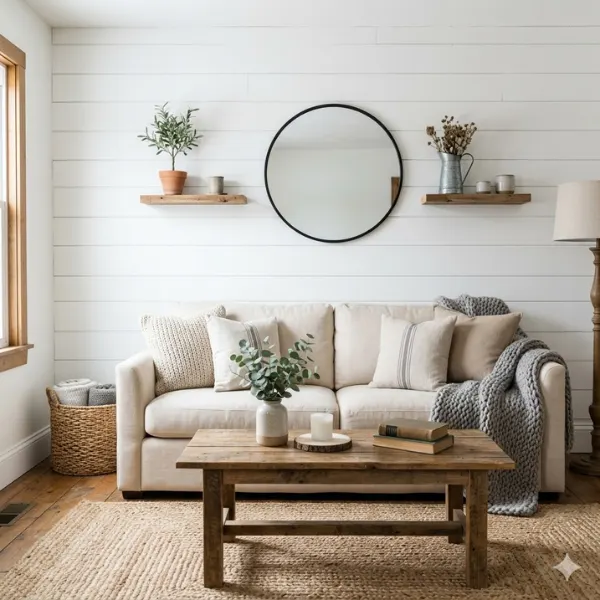
This one is a classic for a reason. The white shiplap farmhouse living room takes horizontal wood paneling — painted crisp white — and uses it to give plain walls instant architectural character. Think Joanna Gaines, Magnolia Network, and that perfect mix of rustic charm and modern cleanliness. It’s warm, it’s welcoming, and it photographs beautifully (hello, Pinterest boards).
Why It Works
Shiplap adds texture to white walls without adding color, which means the room stays light and airy while gaining real visual depth. The horizontal lines also make rooms feel wider, which is a great bonus in narrower living rooms. Paired with farmhouse staples like linen sofas, reclaimed wood accents, and a statement fireplace, shiplap becomes the backbone of the whole design.
Best For
Medium to large living rooms. Homes with a rustic, country, or American farmhouse aesthetic. Spaces that feel flat or boxy and need architectural interest without a full renovation.
Styling Tips
- You don’t need real wood shiplap — MDF boards from the hardware store painted white work just as well and cost a fraction of the price.
- Install shiplap on one feature wall, not all four. The wall behind your sofa or around your fireplace is the best choice.
- Pair with a soft gray or cream linen sofa, not white — this stops the room from looking washed out.
- Add a reclaimed wood coffee table or floating shelf for the rustic contrast shiplap needs.
- Use woven baskets, galvanized metal accents, and some simple greenery to complete the farmhouse feel.
4. Japandi Zen White Space
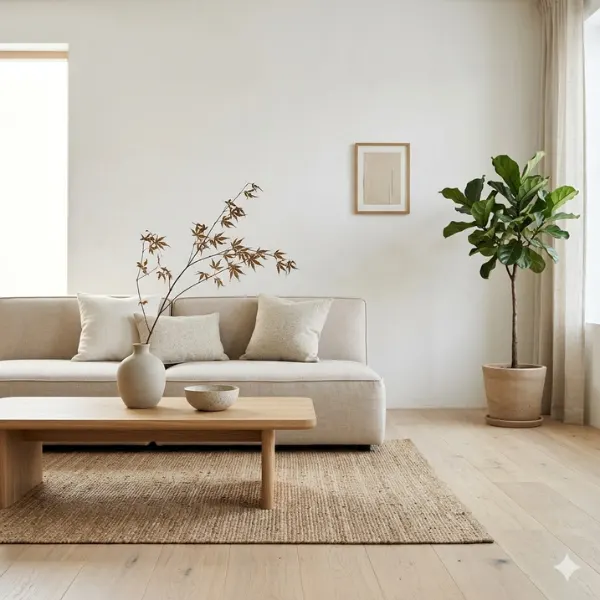
Japandi is the design style the internet can’t stop talking about — and for good reason. It blends Japanese minimalism with Scandinavian simplicity to create spaces that feel impossibly calm and refined. A Japandi white living room strips everything back to the absolute essentials, uses natural materials almost exclusively, and lets the white space around objects breathe. This is the ultimate “less is more” room.
Why It Works
Japandi design is built on the Japanese concept of wabi-sabi — finding beauty in imperfection and simplicity. White walls provide the neutral canvas this philosophy needs. Every piece of furniture earns its place, every material is natural and honest (wood, ceramic, linen, stone), and the result is a room that never feels crowded or anxious. It’s also very easy to maintain because there’s simply less stuff in it.
Best For
Small to medium living rooms. Minimalists or anyone who gets overwhelmed by clutter. People who want a genuinely calming space to decompress at the end of the day.
Styling Tips
- Keep your furniture low to the ground — low sofas, floor cushions, and low coffee tables are all Japandi staples.
- Choose matte finishes over shiny ones: a matte ceramic vase beats a glossy one every time.
- Use only two or three decorative objects maximum, and make sure each one is intentional and beautiful.
- Add a single fiddle leaf fig or a grouping of small potted plants to bring in a bit of life.
- Avoid anything symmetrical — Japandi styling is deliberately slightly asymmetrical and organic.
5. Coastal White and Blue Escape
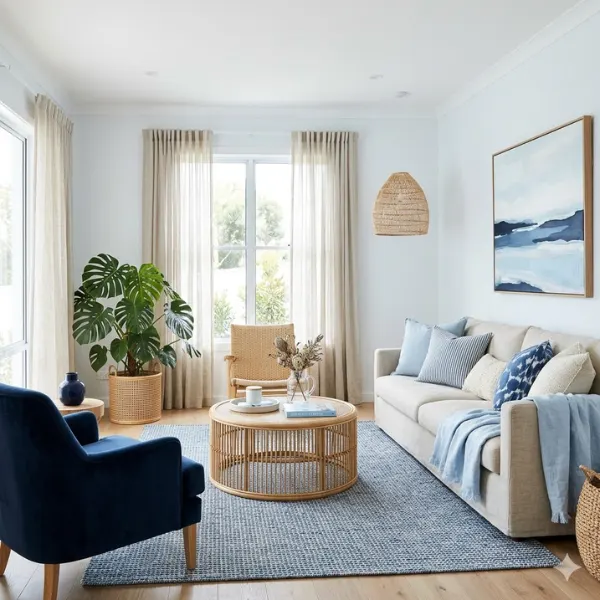
If there’s one color combination that makes people feel instantly relaxed, it’s white and blue together. The coastal white and blue living room brings the feeling of a seaside retreat into your home, no matter where you actually live. Think crisp white walls, varying shades of navy, sky blue, and aqua through cushions and textiles, and natural textures like rattan and linen that feel like a permanent beach house.
Why It Works
White mimics the brightness of sand and open sky, making it the perfect coastal base. Blue accents in different depths — from pale powder blue to deep navy — create a layered, sophisticated look rather than a cartoon “beach house” cliché. The trick is to keep the blues tonal and let white do most of the work. The result is a room that feels breezy, fresh, and endlessly relaxing.
Best For
Any size living room. Coastal homes, lakeside properties, or anyone who loves the ocean and wants that feeling all year round. Also works beautifully in sun-filled south-facing rooms.
Styling Tips
- Stick to a white with a very slight cool undertone — too warm and it won’t read as coastal.
- Layer at least three different blues: one pale (throw pillows), one mid-tone (a rug or large cushions), and one deep navy (a single armchair or artwork).
- Bring in rattan: a rattan coffee table, pendant light, or side chair immediately signals “coastal” without being cheesy.
- Use linen curtains in a natural oatmeal tone — never white curtains in a white room, the contrast helps everything read clearly.
- Add one or two plants with tropical leaves like a monstera to suggest warm coastal climates.
6. White Gallery Wall Lounge
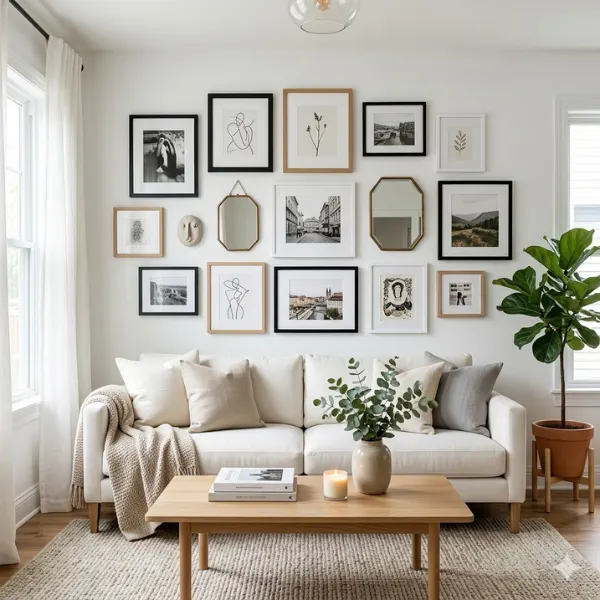
A gallery wall is one of the most effective things you can do to a white living room. It instantly injects personality, color, and visual interest without changing a single piece of furniture. The white gallery wall lounge uses the white walls as a literal art gallery backdrop — crisp, clean, and curated — with a collection of frames and artwork that tells a story about the people who live there.
Why It Works
White walls are the best backdrop for art that exists. The neutral tone doesn’t compete with colors in the artwork, which means every piece looks better against white than it would against any other color. A well-arranged gallery wall also gives a white room an instant focal point — something for your eye to land on and explore — which solves the number one complaint people have about white rooms: that they feel empty.
Best For
Any size living room, but especially impactful in medium and large spaces with generous wall space. Perfect for renters who can’t make structural changes but want a space that feels completely personal.
Styling Tips
- Mix frame sizes and shapes but stick to one finish — all black frames, all natural wood, or all white. This keeps it cohesive even when the artwork inside varies wildly.
- Use paper cutouts or sticky notes to plan the layout on the floor before hammering a single nail.
- Mix photography, illustration, abstract prints, and even a decorative object or mirror in the arrangement.
- Leave slightly more space between frames than feels natural — overcrowding makes it feel chaotic rather than curated.
- Center the gallery around the sofa or a key piece of furniture so it anchors the room rather than floating randomly on the wall.
7. Monochrome Black-and-White Drama
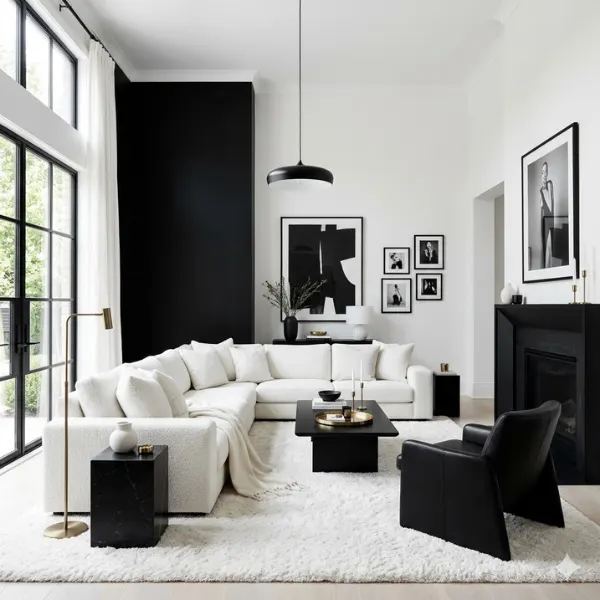
This one is bold, graphic, and genuinely stunning when done right. The monochrome black-and-white living room leans into the contrast between crisp white and deep black to create a space that feels sophisticated, editorial, and totally timeless. It’s the interior design equivalent of a classic tuxedo — clean lines, strong contrast, and effortlessly cool.
Why It Works
Black and white together create a high-contrast environment that feels energizing and sharp. When white is the dominant color (around 70-75% of the room) and black is used as an accent, the room feels dramatic without being heavy. The key is making sure the black elements have weight and purpose — a black fireplace surround, black metal window frames, a black side table — rather than scattered tiny details that look random.
Best For
Medium to large living rooms. People with a bold, confident design sensibility. Homes with great architectural features like high ceilings, large windows, or a statement fireplace that can anchor the look.
Styling Tips
- Keep the ratio roughly 70% white, 20% black, and 10% a soft neutral like warm gray or aged brass.
- Use black in large, intentional pieces: a black leather armchair, black pendant light, black picture frames in a cluster.
- Add texture through white elements — a bouclé sofa, a plush white rug, white linen curtains — so the room doesn’t feel flat or cold.
- Bring in one or two pieces of large-scale black-and-white artwork to reinforce the palette.
- Avoid brown wood tones here — they break the graphic quality of the scheme. Stick to painted black or ebony-stained wood instead.
8. Textured Bouclé White Living Room
Bouclé — that curly, loopy fabric that feels like a hug — has become one of the most popular upholstery choices for white living rooms, and once you see it in person you understand why. The textured bouclé white living room uses this tactile, creamy fabric as a hero material to create a space that’s soft, layered, and incredibly inviting. It’s cloud-like and luxurious without trying too hard.
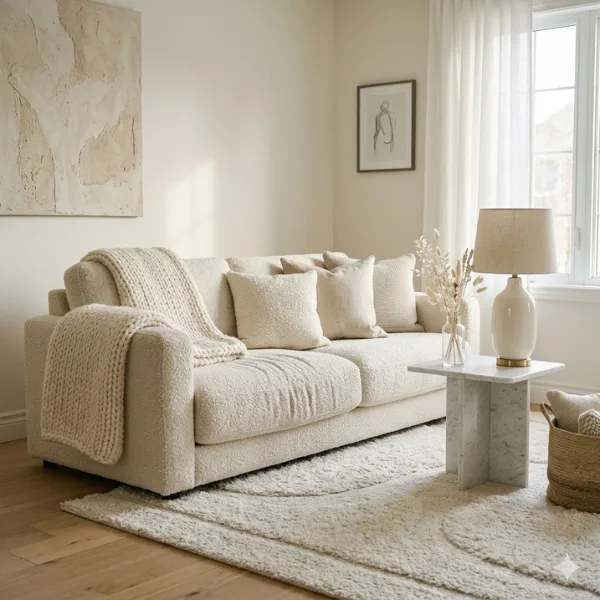
Why It Works
Bouclé adds warmth and texture to an all-white or near-white room without adding any color. Its loopy, nubby texture catches light differently depending on the time of day, which means the room looks slightly different morning, afternoon, and evening — it never feels static. Paired with other soft textiles, it creates a room that’s all about touch and comfort.
Best For
Small to medium living rooms. Anyone who wants a luxurious-looking space on a manageable budget (bouclé sofas are much more affordable than they look). Renters and homeowners who want maximum comfort with minimum fuss.
Styling Tips
- A bouclé sofa is the star of this look — choose one in cream, natural white, or the palest warm gray.
- Layer a chunky knit throw over one arm for added texture and warmth.
- Add a boucle or shag rug underneath in a matching cream or off-white to create a tone-on-tone texture story.
- Use smooth, sleek accessories to contrast the bouclé — a marble side table, a glass vase, or a polished ceramic lamp — so it doesn’t all blend into one fuzzy mass.
- Brush up bouclé regularly with a soft lint brush to keep it looking its best.
9. White with Warm Wood Accents
This is probably the most universally loved white living room combination in existence — and for good reason. White walls paired with warm natural wood create a balance that feels both modern and timeless, clean and lived-in, airy and grounded. It works in every style from contemporary to rustic, in every size room, and suits nearly every taste.
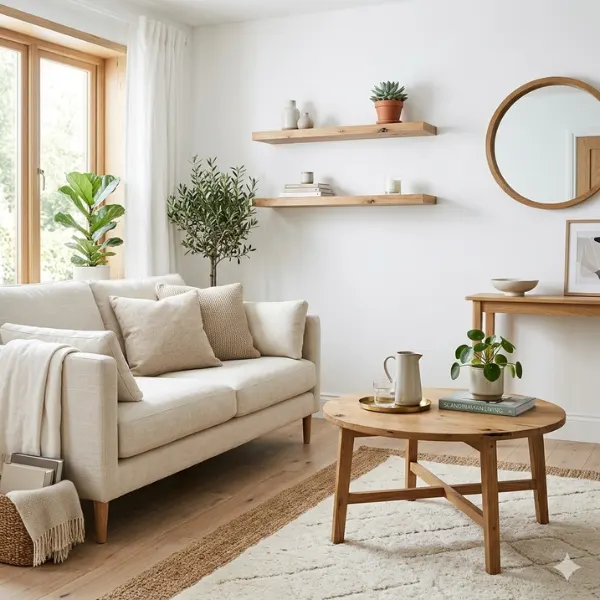
Why It Works
Wood introduces natural warmth and organic texture that white walls alone simply cannot provide. The grain, the color variation, the imperfections of real wood are all things that make a room feel human and alive. When you pair warm honey, oak, or walnut tones with a white backdrop, each one makes the other look better — the wood looks richer, the white looks fresher, and the whole room feels balanced and complete.
Best For
Literally any living room in any size, style, or budget. This combination is foolproof and works with virtually every design direction from Scandi to farmhouse to mid-century modern.
Styling Tips
- Choose one dominant wood tone and stick to it — mixing too many different wood finishes (especially in a small room) makes it feel chaotic.
- Oak is the most versatile wood for white rooms — it reads as warm without being too yellow or too dark.
- Use wood in layers: a wood coffee table, wood floating shelves, a wood-framed mirror, and possibly wood flooring.
- Keep upholstery in white, cream, or soft linen to let the wood be the warm element.
- Add a few plants to bridge the gap between the white walls and the natural wood and make the whole scheme feel cohesive.
10. Biophilic White Living Room with Indoor Greenery
Biophilic design is the practice of bringing nature inside your home, and there’s no better backdrop for lush greenery than a white room. The biophilic white living room uses plants — lots of them, in varying sizes — as the primary decorative element. The result is dramatic, fresh, and feels like living in a botanical garden.
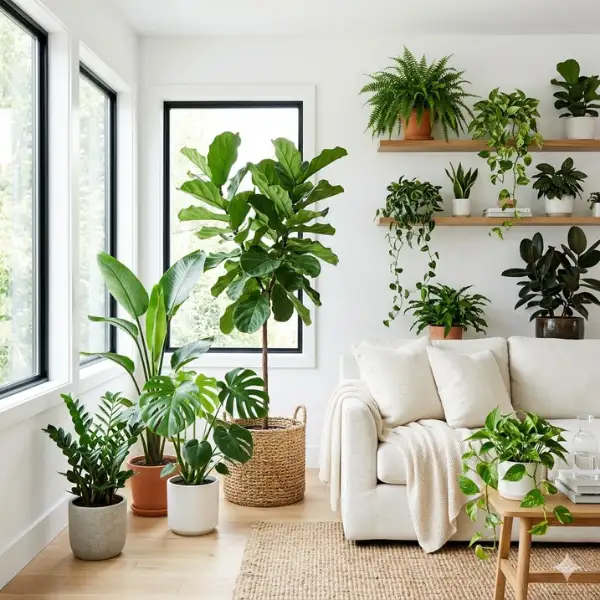
Why It Works
Green plants against white walls create one of the most striking and natural-looking color combinations you can achieve in a home. The white makes every shade of green pop — from the pale lime of a pothos to the deep emerald of a rubber tree. Biophilic design also has real, proven benefits for mental wellbeing: plants reduce stress, improve air quality, and make a space feel alive in a way that no candle or cushion can replicate.
Best For
Any size living room, but especially impactful in larger spaces where you can really go big with floor plants. Also brilliant for apartments where outdoor space is limited — this brings the outside in.
Styling Tips
- Think in three levels: tall floor plants (like a fiddle leaf fig or bird of paradise), medium plants on furniture (like a snake plant or ZZ plant), and small plants on shelves and window sills.
- Use simple white or terracotta pots to keep the focus on the plants themselves rather than decorative containers.
- Group plants in odd numbers — threes and fives look more intentional than pairs.
- Don’t worry about having all the same species — variety in leaf size, shape, and shade creates the most visually interesting biophilic effect.
- If you’re not great with plants, start with a snake plant and a pothos — both are virtually indestructible.
11. White Boho Eclectic Lounge
Who says white living rooms have to be restrained? The white boho eclectic lounge uses white as a neutral foundation but then layers on the personality — woven wall hangings, mix-and-match cushions, vintage finds, global textiles, and all the textures you love. It’s free-spirited and vibrant without ever feeling chaotic, because the white base keeps everything from tipping into overwhelming.
Why It Works
Bohemian style relies on layering lots of different textures, patterns, and objects from different cultures and eras. Without a grounding element, this can quickly feel like a yard sale. White walls and a mostly white palette act as the anchor that makes all the eclectic elements feel curated and intentional rather than random. The white gives the eye a place to rest between the richer, more complex elements.
Best For
Any size living room but especially great in larger spaces where you have room to really layer. Perfect for creative personalities, travelers, and anyone who’s collected beautiful things over time and wants to display them without it looking messy.
Styling Tips
- Start with a white sofa or a large cream-colored sofa as your base. This is what grounds the whole boho scheme.
- Layer cushions in different textures: embroidered, tasseled, woven, velvet — mix freely but keep a rough color story (warm tones, or cool tones, or earthy tones).
- Hang a large macramé wall hanging or woven textile behind the sofa as a statement piece.
- Bring in a Moroccan or Turkish-style rug with pattern and color for the floor.
- Display collected objects, vintage finds, and travel souvenirs on open shelving with plants woven between them.
12. Luxe White with Gold and Marble Touches
This is the white living room that makes people stop and say “wow.” The luxe white with gold and marble living room takes the purity of white and elevates it with the richest possible materials: veined marble surfaces, warm gold hardware, and plush, oversized furniture. It’s glamorous, sophisticated, and feels like a five-star hotel — but when it’s done right, it also feels like a real home.
Why It Works
White and gold is a combination that has been used in luxury interiors for centuries, and it works because gold appears even richer against white than it does against any other color. Marble adds natural pattern and a sense of permanence. Together, these materials create a room that reads as genuinely high-end without relying on loud color or busy pattern — the beauty is in the quality and finish of the materials themselves.
Best For
Medium to large living rooms, especially those with good ceiling height. Ideal for homeowners who want a permanent, lasting design statement rather than a trend-driven look. Also suits open-plan living and dining spaces.
Styling Tips
- Choose marble for your largest flat surfaces: a marble coffee table, a marble fireplace surround, or marble side tables. Even a marble tray on an ottoman counts.
- Use gold accents in hardware and fixtures — lamp bases, curtain rods, cushion zipper pulls, picture frame edges.
- Keep upholstery in crisp white or the richest cream velvet you can find.
- Hang floor-length white silk or velvet curtains and let them pool slightly on the floor.
- Edit ruthlessly — this look only works when every single item is beautiful. One cheap-looking accessory ruins the whole effect.
13. White Loft-Style Industrial Space
Industrial style in a white room sounds contradictory, but it’s one of the most interesting combinations in interior design. The white loft-style industrial space uses exposed structural elements — raw concrete, steel beams, iron pipes, brick painted white — against a crisp white backdrop to create a room that feels urban, creative, and full of character. It’s edgy without being dark and modern without being cold.
Why It Works
Industrial spaces are defined by their raw, unfinished materials. When you paint those materials white — or let them exist naturally against white walls — they become design features rather than eyesores. White amplifies the texture of concrete, brick, and metal, making them look deliberate and cool rather than unfinished. The result is a room with real urban grit but the lightness and freshness of white.
Best For
Open-plan lofts, warehouse conversions, or any space with high ceilings and large windows. Also works in regular homes where you deliberately introduce industrial elements like Edison bulb lighting, pipe shelving, or concrete-finish accessories.
Styling Tips
- If your walls are brick, paint them white — this keeps the texture while letting the room stay light.
- Use Edison bulb pendant lights or a cluster of industrial cage lights as your main lighting feature.
- Opt for furniture with metal legs and frames — a leather sofa with black iron legs, a glass coffee table on iron frames.
- Add pipe shelving on one wall, styled with books, plants, and a few decorative objects.
- Keep the palette simple: white, black, and natural metals (iron, steel, bronze). Don’t introduce color here — it breaks the raw, honest quality of the design.
14. White Maximalist with Bold Art Pops
Just because a room is white doesn’t mean it has to be quiet. The white maximalist living room is for the people who love color, love art, and love statement pieces — but also want a space that feels cohesive rather than chaotic. Here, white does its best work as the unifying backdrop for a collection of bold, expressive artworks and vibrant accent pieces.
Why It Works
Maximalism is about abundance — more art, more objects, more color, more personality. Without a neutral base, maximalism tips into visual chaos. White walls give every colorful piece room to breathe while making the whole collection feel like a deliberate gallery rather than a pile of stuff. The white absorbs all that creative energy and channels it into something that feels curated and exciting.
Best For
Large living rooms with good wall space. Art collectors, creatives, and people who have a lot of beautiful things they want to display. Anyone whose soul rebels at minimalism but still wants a room that feels intentional.
Styling Tips
- Commit to one or two large-scale, very bold art pieces as your anchors — large abstract canvases in hot pink, cobalt, emerald, or terracotta work brilliantly against white.
- Use white furniture so the room reads as “white base with art pops” rather than “everything competing.”
- Layer color in through cushions and throws that pick up tones from your artwork.
- Lean art against walls rather than hanging everything — it gives a more relaxed, collected feel.
- Add a colorful vintage rug to ground the space and echo the artwork’s palette.
15. White Arched Niche and Built-In Shelving Room
Architecture is one of the most underrated tools in interior design, and this idea uses it to glorious effect. The white arched niche and built-in shelving living room adds permanent architectural character through arched doorways, curved wall niches, and floor-to-ceiling built-in shelving — all painted white — to create a room with serious designer credentials without a single piece of expensive furniture.
Why It Works
When architecture is beautiful, white amplifies it. A white arched niche or a wall of white built-in shelving becomes a feature in its own right. These elements add depth, dimension, and visual interest to what would otherwise be a flat white room. They also solve storage problems elegantly — styling open shelving with books, plants, ceramics, and art means your storage becomes your decor.
Best For
Medium to large living rooms where you can dedicate a full wall to shelving. Also brilliant in older homes with existing architectural features like alcoves, chimneybreasts, or structural arches that can be enhanced rather than hidden.
Styling Tips
- If you’re adding built-in shelving, paint both the shelving unit and the wall behind it the same white. This creates a seamless, intentional look.
- Style shelves in sections: books in one area, plants in another, ceramics and objects in another. Avoid scattering everything randomly across every shelf.
- Vary the heights of objects on shelves — stack books horizontally under a tall vase, then follow with a low trailing plant. The eye needs variety.
- For arched niches, paint the inside the same white and add a single significant object or a cluster of small candles.
- Add picture lights or LED strip lights inside shelving or niches to highlight your styling after dark.
16. Soft White Romantic French Country Room
Imagine stepping into a Provence farmhouse — sun-faded whites, linen slipcovers, carved wood frames, antique mirrors, and the smell of lavender. That’s the feeling of the French country white living room. It’s romantic, slightly imperfect, and deeply beautiful in the most understated way. This style doesn’t try too hard — it simply lets beautiful, well-worn things exist together in harmony.
Why It Works
French country style uses white in its softest, most aged form — chalky whites, linen whites, antique whites. Nothing is crisp or new-looking; everything has a history or at least feels like it does. This approach creates a room that feels incredibly comfortable and lived-in without ever looking sloppy. The carved wood furniture, the gilded mirror, the toile or floral accent textiles all add richness that keeps white from reading as cold.
Best For
Small to medium living rooms. Older homes with original features like cornicing, fireplace surrounds, or sash windows. Anyone who loves antiques, vintage markets, and things with a story.
Styling Tips
- Use chalk paint or a limewash paint in a soft white — the flat, slightly uneven finish is part of the charm.
- Look for carved wood furniture painted in aged white or very pale gray. Thrift stores and antique markets are perfect for this.
- Add a gilded or heavily ornate vintage mirror as a key piece — it adds glamour without formality.
- Use toile or soft floral prints on at least one cushion or curtain panel to signal the French country direction.
- Fresh flowers are non-negotiable in this room — a simple bunch of peonies, roses, or lavender in a ceramic jug is the finishing touch.
17. White Small-Space Apartment with Mirrors
When your living room is small, white becomes your most powerful ally — and mirrors become your second. This idea is specifically designed for compact apartments and smaller rooms where you need to create the illusion of more space, more light, and more depth. Done well, a small white living room can feel twice its actual size.
Why It Works
White reflects light and creates an optical illusion of space — this is a proven, well-documented design principle. Mirrors take that effect even further by literally reflecting the room back at itself, doubling the perceived depth and bouncing natural light all the way around the space. Together, white and mirrors are the most effective small-room tools in existence, and they cost far less than knocking down a wall.
Best For
Small apartments, studio flats, compact urban living rooms. Renters who need maximum impact with minimum permanent changes. Anyone working with awkward proportions, low ceilings, or limited natural light.
Styling Tips
- Hang a large mirror — as large as you can — on the wall directly opposite your main window. This bounces daylight deep into the room.
- Use furniture with visible legs (no floor-length skirts or heavy base units) — seeing the floor underneath furniture makes the room feel less congested.
- Choose furniture in white or very pale tones so the whole room reads as one seamless, airy space.
- Use one large rug rather than a small one — counter-intuitively, a large rug makes a small room feel bigger because it defines the space clearly.
- Keep window treatments light and minimal — sheer white curtains hung high above the window frame to maximize perceived ceiling height.
18. White Japandi-Boho Fusion Room
This is one of the most interesting combinations in contemporary design: the restraint and calm of Japandi meets the warmth and personality of bohemian style, all wrapped in a white room. It sounds like a contradiction but it’s actually one of the most livable, beautiful styles you can create — calm enough to relax in, personal enough to feel like you.
Why It Works
Japandi provides the clean white structure, the natural materials, and the low-clutter discipline. Boho provides the handmade textiles, the warming layers, and the personal character. White holds both styles together, acting as the referee that keeps the boho elements from overwhelming the Japandi calm. The result is a room that feels both serene and soulful.
Best For
Small to medium living rooms. People who love minimalism in theory but find it too cold in practice. Creative personalities who also value calm and order. Perfect for anyone who shops at both MUJI and a local crafts market.
Styling Tips
- Start with the Japandi bones: low furniture, natural materials, maximum white space, and very few objects.
- Then layer in one or two boho elements at a time: a handwoven throw, a macramé wall hanging, a patterned cushion.
- Use natural materials throughout — rattan, linen, jute, wood, ceramic — as the common thread between both styles.
- Keep plants in simple ceramic pots, not brightly patterned ones, to honor the Japandi side.
- Stop before it gets busy. The difference between Japandi-boho and just boho is discipline — every addition needs to earn its place.
19. White Velvet and Sculptural Furniture Lounge
This is the white living room for people who genuinely love furniture as art. The white velvet and sculptural furniture lounge uses statement pieces — a curved velvet sofa, an organic coffee table, an architectural accent chair — as the stars of the show. Everything else is white and quiet so that these beautiful, sculptural furniture pieces can do their thing.
Why It Works
Sculptural furniture has incredible visual impact in a white room because there’s nothing competing with it. A curved, cloud-like sofa against a crisp white wall looks like a piece of art. White as a backdrop essentially turns your living room into a gallery where the furniture is the exhibit. The velvet adds richness and depth through its light-catching texture without introducing color.
Best For
Medium to large living rooms. Design enthusiasts and people who genuinely love furniture. Anyone who wants a room that looks like it belongs in an architecture magazine without spending a magazine-level budget on everything.
Styling Tips
- Invest in one truly great sculptural piece — the sofa is the strongest choice. A curved, organic form in cream or white velvet is transformative.
- Choose a coffee table with an interesting shape — a kidney curve, an irregular organic form, or a sculptural stone piece.
- Keep everything else minimal and recessive: white walls, simple white rug, sheer white curtains. The furniture needs the spotlight.
- Add one statement light fitting above the seating area — a sculptural pendant in alabaster, rattan, or smoked glass.
- Resist the urge to add lots of cushions and accessories — this room’s beauty is in its restraint and the quality of the key pieces.
20. White Coastal Farmhouse with Rattan and Linen
The coastal farmhouse is the relaxed, grown-up version of the classic beach house. It combines the casual, breezy quality of coastal style with the warmth and natural materials of farmhouse design — all anchored in a white base. Rattan furniture, linen upholstery, washed-wood accents, and nautical-but-not-kitsch details create a room that feels like a permanent vacation.
Why It Works
The combination of white, rattan, and linen creates one of the most naturally harmonious material palettes in interior design. These three elements have been used together in coastal and tropical interiors for generations because they genuinely belong together. Rattan’s warmth stops white from feeling cold, linen’s softness stops it from feeling hard, and the white base keeps rattan and linen from reading as too heavy or beachy-themed.
Best For
Any size living room. Beach houses, lakeside homes, or anyone who wants coastal feeling inland. Great for warm climates where the combination of light materials and white creates a naturally cooler-feeling room.
Styling Tips
- Use a rattan or wicker coffee table as your central furniture piece — this is the key that unlocks the whole coastal farmhouse look.
- Choose a loose-cover linen sofa in natural, oatmeal, or pale blue for the most authentic coastal farmhouse feel.
- Add a bleached or weathered wood element: a driftwood-style console table, whitewashed wood shelving, or a pale wood fireplace mantel.
- Keep your color accent palette simple: natural sand tones, soft sage, and one pop of faded blue.
- Use simple white ceramic and woven baskets for storage and decor rather than anything with a nautical motif — anchors and ropes are always a step too far.
21. White Moody Candlelit Evening Room
This might be the most surprising idea on this list: a white room that’s designed specifically for evenings. While white living rooms are famous for being bright and airy, this concept embraces what happens to white after dark — how candlelight, warm lamp glow, and low-level lighting turn white walls into a golden, atmospheric backdrop that’s genuinely moody and romantic.
Why It Works
White is uniquely responsive to light. In daylight it’s crisp and fresh; in warm artificial light it transforms completely, taking on the amber and golden tones of whatever light source surrounds it. A white room with a carefully designed evening lighting scheme — multiple lamps at low levels, clusters of candles, possibly a dimmer on the overhead — becomes an entirely different room at night. You essentially get two rooms for the price of one.
Best For
Any size living room. Particularly effective in rooms where the inhabitants work during the day and use the space mostly in the evenings — the white room becomes their atmospheric retreat after dark.
Styling Tips
- Invest in at least three table lamps and two floor lamps rather than relying on overhead lighting. Layered low lighting is the secret.
- Install a dimmer on any overhead lights — being able to drop the ceiling light to 10% changes everything.
- Use warm-toned bulbs throughout (2700K or lower) — cool white bulbs will make your evening room feel like an office.
- Place clusters of pillar candles and tea lights on your coffee table, fireplace, and shelving. Use them every single evening.
- Choose soft, plush textures — velvet cushions, chunky knit throws, a deep rug — that absorb and radiate warmth in low light.
22. White Terra Cotta Accent Living Room
Terra cotta is one of the most beautiful accent colors you can pair with white, and it’s having a major design moment right now. The white terra cotta accent living room uses the earthy, warm tones of burnt orange and clay against a white backdrop to create a room that feels grounded, rich, and connected to the natural world. It’s unexpected, sophisticated, and deeply satisfying to look at.
Why It Works
Terra cotta and white is a combination with ancient roots — think Mediterranean architecture, Moroccan tiles, Italian farmhouses — which is why it feels so naturally right. Terra cotta brings warmth and earthiness that white needs to feel truly alive. It’s a color with depth and complexity: not quite orange, not quite brown, not quite red — which means it adds richness without the aggression of a brighter accent color.
Best For
Medium to large living rooms. Homes with a Mediterranean, bohemian, or earthy aesthetic. Anyone who loves warm, natural color palettes and wants something more interesting than the standard gray-and-white combination.
Styling Tips
- Introduce terra cotta through ceramics first: a large terra cotta vase, a cluster of terra cotta pots with plants, a ceramic lamp base.
- Add a terra cotta or rust-toned throw pillow on your white sofa — just one or two is enough to establish the palette.
- Look for a rug with terra cotta tones woven into a pattern — this grounds the color in the room’s foundation.
- Use warm white paint (slightly yellow or cream undertone) rather than cool white — it harmonizes much better with terra cotta tones.
- Add dried pampas grass, dried orange slices, or dried botanicals as decor — these are naturally terra cotta-adjacent and reinforce the earthy, organic theme.
23. White High-Ceiling Grand Family Room
Not every living room is small — and if you’re lucky enough to have a large, high-ceilinged space, white is the color that does it the most justice. The white high-ceiling grand family room embraces the scale of a large space with confident, oversized furniture, dramatic lighting, and a layered approach to materials that fills the room beautifully without ever making it feel overcrowded.
Why It Works
Large rooms with high ceilings can easily feel cold, echoey, and impersonal. White, when layered correctly with generous furniture, rich textiles, and dramatic lighting, turns a grand space into an equally grand but deeply welcoming room. The key is scale — everything needs to be bigger than you think. Small furniture in a large room always looks sad; large, confident pieces in a large room look incredible.
Best For
Large living rooms, family rooms, and open-plan spaces with ceiling heights above standard. Homes with period features like high cornicing, original plasterwork, or large sash windows. Families who need a space that’s both beautiful and genuinely functional for real life.
Styling Tips
- Hang curtains from ceiling to floor, regardless of where the actual window starts and ends. This makes every window look like a floor-to-ceiling feature.
- Choose an oversized sofa — a generous L-shaped or U-shaped configuration — so the seating fills the space properly.
- Go big with your light fitting: a large chandelier or cluster pendant over the seating area brings the height down to a human scale and creates an intimate atmosphere within the larger space.
- Use a very large rug — if you think you’ve found the right size, go one size bigger.
- Add a fireplace or make the existing one a focal point with an oversized mantelpiece and oversized artwork above it.
24. White Earthy Travertine and Stone Living Room
This is the most elevated and architecturally sophisticated idea on the list. The white travertine and stone living room uses the natural variation and texture of stone — travertine floors, a stone fireplace, a travertine side table, limestone accents — against white walls to create a room that feels ancient and modern simultaneously. It’s quiet, confident design at its most refined.
Why It Works
Travertine and stone have the same quality as white: they’re both neutral but deeply textured and complex. Together they create a room that’s entirely within a neutral palette but has extraordinary visual richness because every surface has natural variation, porous texture, and a sense of geological permanence. This combination is used in some of the world’s most sophisticated interiors because it never looks cheap, never dates, and only gets better with age.
Best For
Medium to large living rooms. Design enthusiasts with a love of natural materials and architectural interiors. Homeowners doing a longer-term renovation who want a truly timeless material palette.
Styling Tips
- Travertine side tables and coffee tables are now widely available at various price points and are the easiest way to introduce the material.
- If you have a fireplace, consider a polished limestone or travertine surround — this is the statement that defines the whole room.
- Keep furniture in white, cream, or very pale greige (gray-beige) so the stone can be the textural hero.
- Use minimal decor — a single oversized candle, one large architectural plant in a simple pot, one significant piece of art.
- Combine with soft, plush textiles like cashmere throws or mohair cushions to create a tactile contrast between hard stone and soft fabric.
Common Mistakes to Avoid in a White Living Room
Getting a white living room right is wonderfully achievable — but there are a few mistakes that trip up almost everyone the first time. Here’s what to watch for:
Using only one type of white. There are hundreds of whites and they don’t all work together. Mixing a cool bright white on the walls with a warm cream sofa and an off-white rug creates a visually confused room where nothing looks quite right. Choose your white direction (warm or cool) and stick to it.
Ignoring texture completely. A white room with no texture looks flat, empty, and uninviting. Texture is how white rooms get their depth and warmth — bouclé, linen, jute, rattan, wood, stone. If your room looks sterile, it’s almost always a texture problem.
Going too minimal. Minimalism is a style choice, not a requirement of white rooms. Stripping everything out in the name of “keeping it clean” often results in a space that feels more like a showroom than a home. Add some lived-in warmth through plants, books, candles, and personal objects.
Using white paint straight from the tin on every surface. Painting walls, ceiling, skirting boards, and woodwork all in the same standard white almost always looks flat and dull. Vary the finish (matte for walls, eggshell for woodwork) or use slightly different whites for different surfaces to create depth.
Neglecting lighting. White rooms need layered lighting. One overhead light on a white room is a disaster — it makes everything look flat and clinical. Layer floor lamps, table lamps, and candles to give the room warmth after dark.
Choosing white furniture without considering practicality. A white sofa is beautiful but requires more maintenance than a darker one. If you have children, dogs, or simply live a real life, consider white slipcovers (which can be washed) or a very pale warm gray instead of pure white.
Skipping the rug. White walls and white or light floors without a rug make a room echo, feel cold underfoot, and lack definition. A rug is not optional in a white living room — it’s structural.
Conclusion
A white living room done right is one of the most beautiful, timeless, and livable spaces you can create. The key to making it work every single time is remembering that white is a starting point, not a destination. It’s the canvas — and everything you layer on top is what makes it yours.
Whether you go calm and Japandi, warm and farmhouse, dramatic and monochrome, or lush and biophilic, the 24 ideas in this guide all prove the same thing: white is endlessly versatile, endlessly forgiving, and endlessly rewarding to design with.
Start with what speaks to you — the style, the feeling, the vibe you want to walk into at the end of the day. Then layer your textures, add your accents, bring in your light, and let the white do what it was born to do.
Frequently Asked Questions
What is the best white paint color for a living room? It depends on your room’s light and the style you’re going for. For warm, cozy spaces, try Benjamin Moore White Dove or Sherwin-Williams Alabaster. For crisp, bright rooms, Chantilly Lace by Benjamin Moore or Pure White by Sherwin-Williams are both excellent. Always test a large swatch on your wall for at least 48 hours before committing — white paint changes dramatically depending on the light in your specific room.
How do I stop a white living room from looking cold? Add warmth through texture and material rather than color. Warm wood accents, bouclé or linen upholstery, jute or wool rugs, plenty of plants, and layered warm-toned lighting (2700K bulbs) will transform a cold white room into a deeply welcoming space. Also check your paint — a blue or green undertone in your white will read as cold, so switch to a white with yellow or pink undertones instead.
What colors work best as accents in a white living room? Almost any color works against white, which is one of white’s greatest strengths. The most popular and reliable pairings are: warm wood tones (natural, not painted), navy and coastal blues, earthy terra cotta and clay, soft sage green, warm gold and brass, and black for graphic drama. The key is to commit to one accent direction and repeat it in at least three places in the room for a cohesive look.
How do I make a small white living room look bigger? Use white throughout (walls, ceiling, large furniture) to blur boundaries and maximize the sense of space. Add mirrors on the wall opposite your windows. Choose furniture with legs rather than floor-hugging bases — seeing floor underneath furniture makes rooms feel less crowded. Use one large rug rather than several small ones. Hang curtains high above the window and let them fall to the floor to maximize perceived ceiling height.
Is a white sofa a practical choice? It depends on your lifestyle. A white sofa is beautiful but requires more care than darker alternatives. If you have children or pets, look for tight-weave performance fabrics in white or near-white that can handle real use — many modern performance fabrics are stain-resistant and wipeable. Alternatively, a removable and washable slipcover sofa gives you the white sofa look with practical peace of mind. Avoid bouclé or highly textured fabrics if you have pets, as fur and pilling are difficult to manage.
How many plants should I put in a white living room? There’s no upper limit — the more the better if you go for a biophilic approach. But if plants are just accent pieces rather than the main decorative theme, three to five plants in varying sizes is a good rule of thumb. Use at least one floor plant (significant height — at least 3-4 feet), one mid-size plant on a shelf or side table, and one or two small trailing plants on windowsills or high shelves.
What type of lighting is best for a white living room? Layer your lighting always — never rely on one source. Use warm white bulbs (2700K maximum, 2400K is even better) throughout. Your living room needs a ceiling light on a dimmer, two or more floor lamps, table lamps on side tables, and ideally some candles. This layering gives you full flexibility from bright functional light during the day to a warm, atmospheric glow in the evenings. Recessed ceiling spotlights work well in white rooms as they don’t interrupt the clean ceiling line.