
15 Creative Ways to Decorate a Blank Bedroom Wall (Stylish Ideas for Beginners)
A blank bedroom wall is one of those things that quietly bothers you every single day. You walk in, glance at it, and think — I really need to do something about that. Then life happens and you move on. But here is the thing: that empty wall is not a problem. It is an opportunity.
I have been decorating bedrooms for years — my own, my friends’, and homes I have helped style from scratch. And one thing I know for certain is that a bare wall does not mean a boring room. It simply means the room is not finished yet.
You do not need to hire an interior designer. You do not need to spend a fortune. You just need to know where to start, what works, and what to avoid. That is exactly what this guide is for. In this article, I am walking you through 15 of the best bedroom wall decor ideas — from simple art arrangements to painted treatments, mirrors, lighting, and soft textiles. Let us get that wall sorted.
Table of Contents
15 Bedroom Blank Wall Decor Ideas That Actually Work
Here are 15 tried-and-tested ideas for decorating a blank bedroom wall. Every one of them is beginner-friendly, budget-conscious, and genuinely effective.
1. One Oversized Statement Artwork
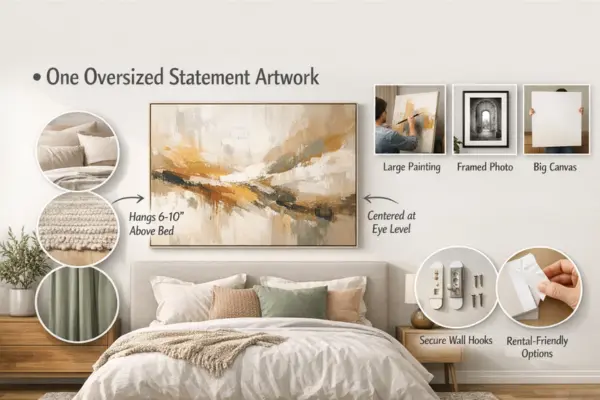
If you want the single fastest way to make a blank wall look finished, this is it. One large piece of artwork — hung with intention — can completely anchor a bedroom and make the whole space feel designed. No gallery arrangement, no fuss. Just one bold, beautiful piece doing all the work.
Why It Works
Large art draws the eye immediately. It fills visual space without crowding the room, and it gives the wall a clear focal point. When art is too small for a wall, it floats awkwardly and looks like an afterthought. When it is the right size, it looks like a deliberate design decision — which it is.
Big art also creates a sense of calm. Instead of lots of small things competing for attention, there is just one strong piece. That simplicity is exactly what a bedroom needs.
Best For
This idea works best above the bed, where the wall tends to be the largest and most visible surface in the room. It also works beautifully above a wide dresser or chest of drawers. If your room is on the smaller side, oversized art is still a great choice — it actually makes small rooms feel bigger and more curated.
If you are a beginner decorator or someone who finds decision-making overwhelming, start here. One piece, one decision, massive impact.
Styling Tips
- Choose artwork that includes at least one colour already present in your bedding, rug, or curtains. This ties the room together without any extra effort.
- Abstract prints are the most versatile option. They suit almost every interior style and come in a huge range of sizes and price points.
- Hang the artwork so the centre sits at eye level — roughly 145 to 150cm from the floor. If it goes above the bed, leave about 15 to 20cm of space between the top of the headboard and the bottom of the frame. This keeps the art visually connected to the bed rather than floating on the wall above it.
- For heavy frames, always use proper wall anchors. For lightweight canvas prints, renter-friendly adhesive strips work well and leave no damage.
- If you are unsure about size, cut a piece of newspaper or brown paper to the dimensions of the artwork and tape it to the wall. Live with it for a day before committing.
2. Curated Gallery Wall
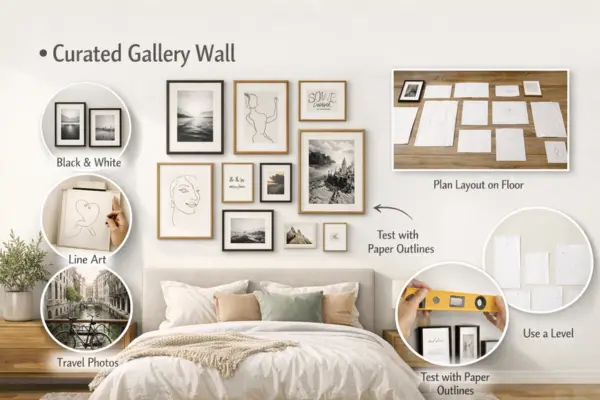
A gallery wall is a collection of frames arranged together on one section of wall. Done well, it is one of the most personal and charming ways to decorate a bedroom. Done without a plan, it can look chaotic and busy. The difference is all in the preparation.
Why It Works
A gallery wall works because it tells a story. Every piece — whether it is a photograph, a print, a postcard, or a simple quote — adds a layer of personality. Bedrooms should feel personal, and nothing achieves that faster than a well-curated collection of things that mean something to you.
It also gives you flexibility. You can start small and add to it over time. You can swap pieces out as your taste evolves. It is a living wall, not a fixed one.
Best For
Gallery walls suit people who love variety and have lots of things they want to display — family photos, travel prints, favourite quotes, small artworks collected over time. They work particularly well on the wall beside the bed or facing it, where you can enjoy the whole arrangement from a comfortable viewing distance.
This idea is also great for renters who want to make a space feel like home quickly, since the investment is low and the pieces can all move with you.
Styling Tips
- Before you hang a single frame, choose one unifying element. This could be frame colour (all black, all natural wood, all white), image tone (all black and white, all warm-toned), or subject (all botanical prints, all travel photos). That one consistent thread is what stops a gallery wall from looking like a jumble.
- Lay all your frames on the floor and experiment with arrangements before touching the wall. Take a photo when you find one you like.
- Cut paper templates in the shape of each frame and tape them to the wall. This lets you see the full arrangement before making any holes. Adjust freely until it feels right.
- Keep spacing consistent — aim for 5 to 8cm between each frame throughout the arrangement.
- Start with a central piece — usually your favourite or your largest frame — and build outward from there.
- Use a small spirit level to keep individual frames straight. Even a slight tilt becomes very noticeable once everything is hung.
3. Small Art with Big Matting
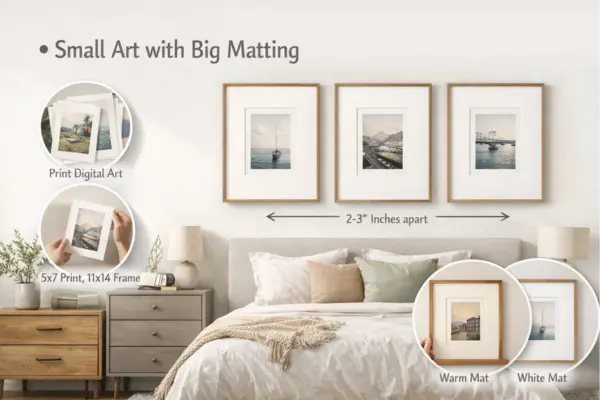
This is one of the cleverest and most affordable tricks in home decoration. Take a small print — something you love but that would look lost on its own — and place it inside a much larger frame with a wide mat (the border of card between the frame and the image). The result looks expensive, polished, and intentional every single time.
Why It Works
The wide mat creates breathing space around the image. That space is what gives the art weight and importance. It is exactly the technique used in proper art galleries and museums, where even small works are given large mats and generous frames to elevate them. You are essentially borrowing that approach for your bedroom wall.
This trick also makes inexpensive prints look far more considered. A simple botanical illustration or a black-and-white line drawing in a large matted frame looks like a deliberate design choice, not a bargain find.
Best For
This idea is perfect for people who already have small prints or photos they love but are not sure how to display them. It also suits minimal and Scandinavian-style bedrooms where clean lines and restrained decoration are the goal. If your bedroom decor is already fairly simple, a row of two or three matted frames above a dresser or along an empty side wall can be the finishing touch the room needs.
Styling Tips
- Aim for the mat to be at least as wide as the image itself — ideally wider. For example, a 10 x 15cm print works beautifully in a 30 x 40cm frame with a wide mat. That difference in size is what creates the luxurious effect.
- Stick to white, off-white, or natural linen mats. They work with everything and never date.
- Hang a row of two or three identically-framed matted prints in a straight horizontal line, with even spacing between them. This looks structured and elegant above a long piece of furniture like a dresser or a console table.
- You do not need to buy expensive original art. Digital prints bought online and printed at a local copy shop cost very little and look great when matted and framed properly.
- Natural wood or thin black frames tend to look the most refined with wide mats. Avoid chunky or ornate frames — the wide mat should be the feature, not the frame itself.
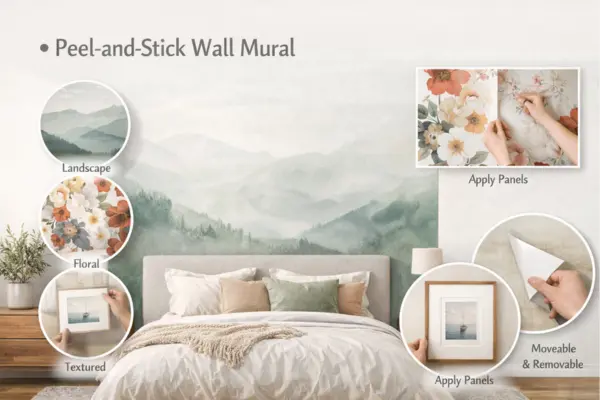
4. Peel-and-Stick Wall Mural
A peel-and-stick wall mural is the closest thing to an instant room transformation that exists. You apply it directly to the wall — like a very large, very beautiful sticker — and the room looks completely different within a few hours. No paint, no paste, no professional needed.
Why It Works
Murals create a sense of place. A soft mountain landscape behind the bed makes the room feel expansive and calm. A lush botanical print feels lush and tropical. A subtle geometric or textured pattern adds depth without distraction. The sheer scale of a mural does something that individual pieces of art simply cannot — it turns the whole wall into the feature.
Modern peel-and-stick murals are also removable, which makes them a genuinely practical option for renters. The adhesive is designed to release cleanly without damaging paint underneath.
Best For
This idea is best for the wall directly behind the bed — the largest, most visible wall in most bedrooms. It suits people who want a dramatic impact without a dramatic amount of effort or expense. It is particularly effective in rooms that feel plain or lack architectural character, since the mural adds all the visual interest the room needs in one move.
Styling Tips
- Measure your wall carefully before ordering. Note both the width and the height, and check the mural dimensions including how the panels align. Most murals come in vertical strips that you apply side by side.
- Choose the mood first, then the image. If your bedroom is a place for rest and calm, go for soft tones — muted landscapes, washed-out botanicals, or subtle textures. If you want energy and personality, bold patterns and deeper colours work well.
- Clean the wall thoroughly before applying and let it dry completely. Even a small amount of dust or moisture will affect how well the panels stick.
- Start from one side and work across, smoothing each panel from top to bottom as you go. A flat edge — even a credit card — helps eliminate bubbles.
- Ask a friend to help. Aligning large panels is much easier with two sets of hands.
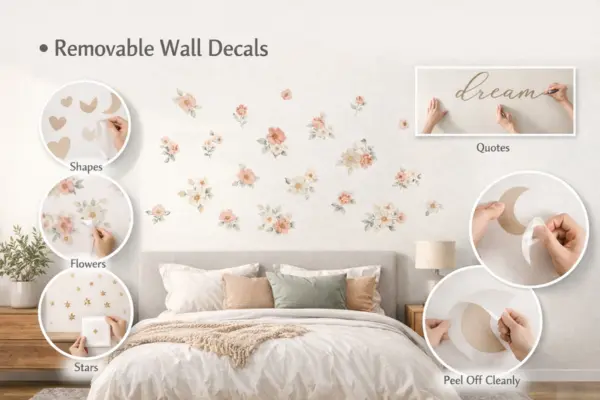
5. Removable Wall Decals
Wall decals are adhesive designs made specifically for walls. They come in an enormous range of styles — from simple botanical shapes and geometric patterns to large-scale designs and lettered quotes. They go up in minutes, come down without damage, and cost very little. For anyone who wants a low-commitment way to add character to a blank wall, decals are hard to beat.
Why It Works
Decals work because they are pure design — no frame, no mat, no hanging hardware. They sit directly on the wall and become part of it. A well-chosen decal can look like hand-painted art, especially from a distance. They are also repositionable on most surfaces, which means you can adjust until you are completely happy with the placement before committing.
They are also lightweight and completely renter-friendly, which makes them accessible to almost everyone.
Best For
Decals are best for people who rent their homes or who like to change their decor regularly. They are also a great starting point for anyone who feels nervous about making permanent changes to a wall. If you want to add interest above a bedside table, create a feature behind the headboard, or simply break up a large expanse of plain wall, decals give you that freedom with zero risk.
Styling Tips
- Choose a decal style that matches your existing decor. If your bedroom is calm and neutral, go for botanical outlines, soft geometric shapes, or simple repeating patterns in a matching tone. If your room has more personality, you can go bolder with a large-scale abstract design or a typographic print.
- Always apply to a clean, dry wall. Wipe the surface down and let it dry fully before positioning anything.
- For large decals, use a level and a measuring tape to get the placement right before peeling the backing off. Mark the intended position lightly with a pencil.
- When removing, peel slowly at a low angle — pulling directly outward rather than straight back. This puts less stress on the wall surface and makes the decal more likely to come away cleanly.
- Avoid applying decals in very cold or very humid conditions, as these affect the adhesive.
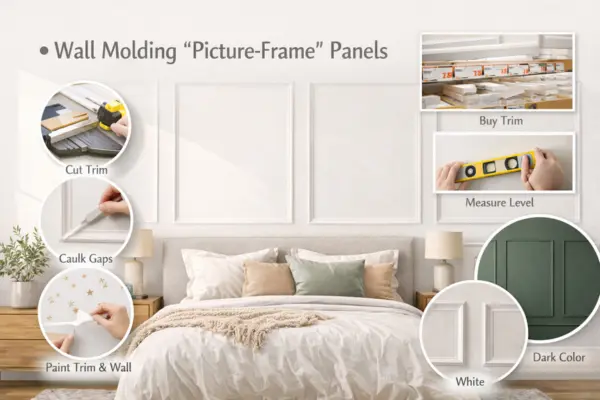
6. Wall Moulding “Picture-Frame” Panels
Wall moulding panels are one of those ideas that look far more expensive and complicated than they actually are. The technique involves attaching lengths of simple wooden trim to the wall to create a series of rectangular or square frames — then painting everything (wall and moulding together) in the same colour. The result looks like the kind of architectural detailing you find in period homes and boutique hotels.
Why It Works
Moulding panels add depth and texture to a flat wall without taking up any floor space. The rectangular shapes create a sense of order and elegance, and the single-colour finish makes the whole thing look seamless and deliberate. It is one of the few DIY projects that truly looks like professional work when done carefully.
It also photographs beautifully, which is why you see it constantly on Pinterest and in interior design magazines.
Best For
This idea works wonderfully on the wall behind the bed, where it creates a built-in headboard effect. It also suits long, wide walls that feel too large for a single piece of art. It is ideal for people who want a permanent, high-impact change rather than something temporary. It suits traditional, classic, and modern-country interior styles particularly well, though it can be made to work in almost any bedroom depending on the colour choice.
Styling Tips
- Start by planning your panel layout on paper. Decide how many panels you want, how large they will be, and how much space you will leave between them. Symmetry is important here — take time to get the measurements right before cutting anything.
- Buy straight lengths of MDF trim from a hardware store. You can ask the store to cut them to your specified lengths to save time.
- Attach the trim using a combination of wood adhesive and small finishing nails for the most secure result. Fill any gaps between the trim and the wall with decorators’ caulk before painting — this step is what gives the finished work that smooth, professional look.
- Paint the entire wall — moulding included — in the same colour. This unified finish is what makes the technique look architectural rather than stuck-on. Deep tones like navy, forest green, or warm terracotta create a dramatic, luxurious effect. Soft neutrals feel calm and timeless.
- Use a spirit level constantly throughout. Even minor tilting becomes very obvious once the paint goes on.
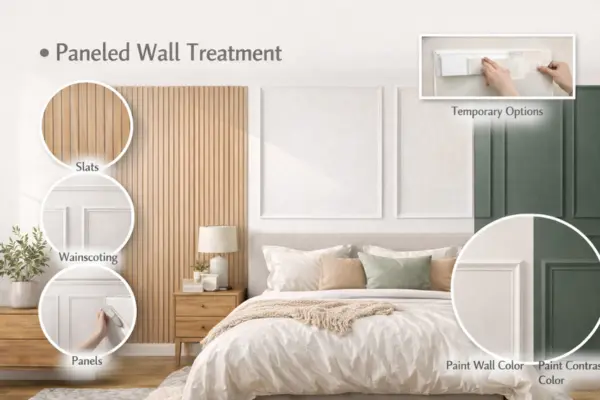
7. Paneled Wall Treatment (Slats, Wainscoting, Shiplap)
A paneled wall treatment goes one step beyond paint and moulding. It adds real physical texture to the wall — material you can see and feel. This category includes vertical wood slats, traditional wainscoting, classic beadboard, and shiplap-style cladding. All of them add warmth and depth to a bedroom wall in a way that very few other treatments can match.
Why It Works
Texture makes a room feel more layered and complete. A flat painted wall, no matter how beautiful the colour, lacks dimension. Panel treatments solve that instantly. They also add an architectural quality that makes a room feel like it was carefully designed — not just decorated.
Vertical slats in particular draw the eye upward, which makes ceilings feel higher. In a low-ceilinged or smaller bedroom, this is a genuinely useful effect.
Best For
This treatment is best for the wall directly behind the bed, where it can act as a built-in headboard or backdrop. It suits people who want a more permanent, considered change to their bedroom rather than something temporary. Wood slats suit modern and Scandinavian-style rooms. Wainscoting suits traditional, farmhouse, and classic interiors. Beadboard works in coastal and cottage-style spaces.
Styling Tips
- If you are new to DIY, pre-made slat panels are the easiest entry point. They come in sections that fix directly to the wall with adhesive and take far less time than cutting and installing individual slats.
- You do not need to cover the entire wall. A section behind the bed — the width of the bed frame plus a little either side — is enough to create a strong focal point.
- Paint after installation for the cleanest finish. This covers fixings, fills any gaps, and gives the treatment a seamless look.
- Consider the spacing of your slats carefully. Wider gaps feel lighter and more open. Tighter spacing feels denser and warmer. Both work — it depends on the atmosphere you want.
- If you rent, ask your landlord before installing anything fixed to the wall. Some panel systems are designed for temporary installation using heavy-duty adhesive strips that leave no damage.
8. One Big Statement Mirror
A large, well-chosen mirror might be the single most practical piece of decor you can add to a bedroom wall. It reflects light, makes the room feel larger, adds visual interest — and you can use it to check your outfit every morning. It is one of those rare decor choices that is both beautiful and genuinely useful.
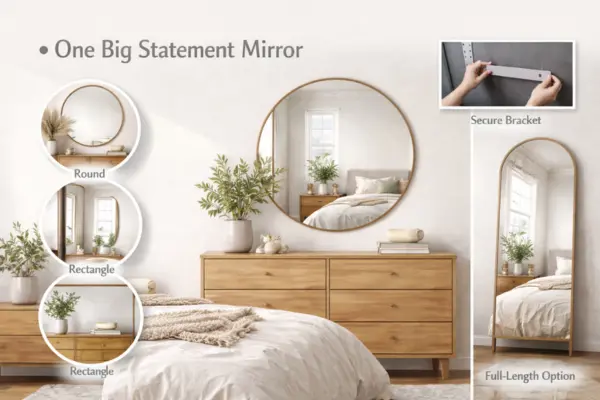
Why It Works
Mirrors create an illusion of space. They bounce natural light around the room and make walls feel further away than they are. In a bedroom that feels cramped or dark, a large mirror on the wall can transform how the whole space feels — without moving a single piece of furniture.
A statement mirror also has a sculptural quality that art does not. The frame, the shape, and the reflective surface together create an object that works as decoration in its own right, regardless of what it reflects.
Best For
This idea is perfect for smaller bedrooms, rooms with limited natural light, and anyone who wants a high-impact change without committing to something permanent. A leaning mirror requires no wall fixings at all. A hung mirror works well above a dresser, beside a window, or as a focal point on an otherwise plain wall.
Arched mirrors suit almost every bedroom style — they are the most versatile shape available. Round mirrors suit modern and minimal spaces. Rectangular mirrors feel more classic and structured.
Styling Tips
- Position the mirror so it reflects something beautiful — a window, a lamp, a plant, or a well-styled shelf. Avoid placing it where it catches an angle of direct sunlight that creates glare from the bed.
- If the mirror is heavy, use the correct wall fixings. Do not rely on adhesive strips for anything above a certain weight — check the product guidelines carefully.
- For a relaxed, unfussy look, lean a large mirror against the wall rather than hanging it. Style the floor around its base with a plant or a small stack of books to ground it visually.
- The frame finish matters more than the shape. Choose based on your existing hardware — door handles, curtain poles, light fittings. Match metals for a cohesive result.
9. Mirror Collage (Many Mirrors Together)
A mirror collage is a gallery wall made entirely from mirrors rather than frames. Multiple mirrors — in different shapes but a unified finish — are arranged together on one wall to create a display that catches light from every angle and adds sparkle and depth to the room. It is bolder than a single mirror and more dynamic than a standard gallery wall.
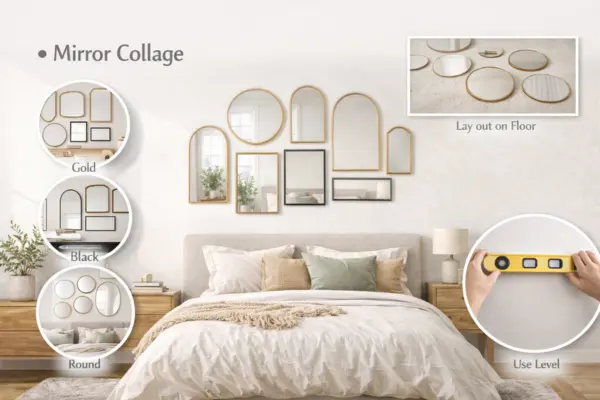
Why It Works
Multiple mirrors work together to multiply the light-reflecting effect. The result is a wall that shifts and glimmers gently as the light in the room changes throughout the day. It creates visual interest from across the room without the need for any artwork or colour — just light, reflection, and form.
It is also more affordable than buying one large statement mirror, since smaller mirrors are considerably cheaper and easier to source.
Best For
This idea is best for anyone who loves the idea of a statement mirror but cannot find one large piece they love, or whose budget does not stretch to a large mirror. It works particularly well in bedrooms that feel too plain or too dark, and it is a great option for medium to large walls where a single mirror would look too small.
It suits contemporary, eclectic, and boho-style bedrooms especially well.
Styling Tips
- Choose one unifying element across all the mirrors. All-brass frames, all-black frames, or all-rattan frames create cohesion even when the shapes and sizes vary.
- Mix shapes — round, oval, arch, rectangular — but keep the sizes in a similar range. A very large mirror next to a very tiny one throws the arrangement off balance.
- As with a gallery wall, lay everything on the floor first and photograph the arrangement before hanging anything.
- Think about the overall shape of the arrangement as a whole. A roughly circular cluster, a loose rectangular block, or a diagonal sweep all work — what matters is that the arrangement has a deliberate shape, not just a scattering of random pieces.
- Use proper fixings for every mirror, even small ones. Glass is heavier than it looks, and the last thing you want is a mirror falling in the night.
10. Vertical Garden Wall (Wall-Mounted Plants)
Wall-mounted plants bring something into a bedroom that no piece of art, mirror, or moulding can replicate — life. A vertical arrangement of plants on a blank wall creates a display that breathes, grows, and changes subtly with the seasons. It feels calming in a way that is hard to explain and impossible to fake.
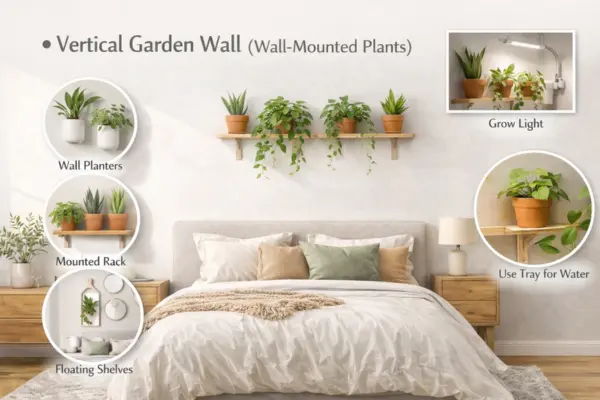
Why It Works
Plants soften a room. They add organic texture, gentle colour, and a sense of the natural world that makes even a plain bedroom feel warmer and more inhabited. On a wall, they become a design feature in their own right — a living installation that costs very little and rewards almost no effort.
There is also good evidence that having plants in a bedroom improves air quality and can contribute to better sleep. Decoration that is also genuinely good for you is rare. Take advantage of it.
Best For
This idea suits bedrooms with at least some natural light, ideally a window nearby that gets a few hours of indirect daylight per day. It is perfect for people who love plants and want to bring more greenery into their space without cluttering the floor. It also works well in rooms that feel too plain or too beige — even a few trailing plants can bring enormous warmth and colour to a neutral space.
Styling Tips
- Start simply. Two or three plants on small floating shelves is enough to create a beautiful wall display. You do not need a full floor-to-ceiling installation.
- Choose plants with similar care needs so maintenance is easy. Pothos, philodendron, and heartleaf plants are all low-maintenance, tolerant of lower light conditions, and trail beautifully when placed on higher shelves.
- Place trailing plants on the highest shelf so they hang downward naturally. More compact, upright plants work better on lower shelves.
- Always use a tray or saucer inside or beneath any wall planter. Moisture seeping into the wall causes damage over time — protect the surface from the start.
- If your bedroom does not get much natural light, consider low-light tolerant plants like snake plants, ZZ plants, or cast iron plants. They are almost indestructible and still look wonderful.
11. Floating Shelves Styled Beautifully
Floating shelves are one of the most versatile things you can add to a bedroom wall. They fill empty space, add display surface, create storage, and give you a place to show the objects and collections that reflect who you are. Styled thoughtfully, a few simple shelves can make a bedroom wall look more considered and personal than any piece of purchased art.
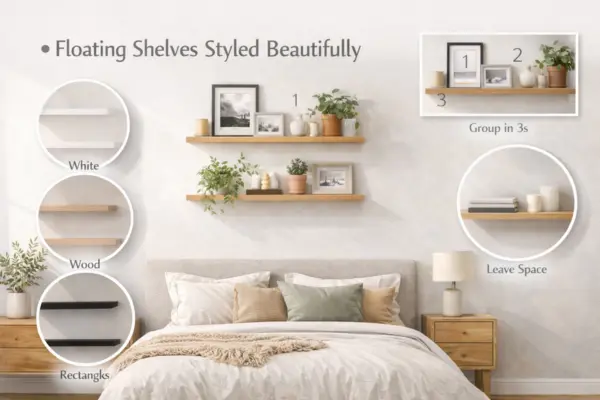
Why It Works
Shelves work because they create layers. Instead of a flat wall with things hung on it, you have depth — objects at different heights, with space between them. That layering is what gives a room the kind of lived-in, curated quality that feels genuinely stylish rather than showroom-neat.
They are also endlessly changeable. You can restyle a shelf in ten minutes when you want something fresh. That flexibility is something permanent wall treatments simply do not offer.
Best For
Floating shelves work above almost any bedroom furniture — dressers, desks, small tables — and they are particularly useful in smaller rooms where floor space is at a premium. They can do the job of a bedside table when mounted at the right height beside the bed, freeing up floor space while still providing surface area for a lamp, a glass of water, and whatever book you are currently reading.
This idea suits every interior style. The shelf material and what you place on it does all the style work.
Styling Tips
- Choose your shelf material based on the room’s aesthetic. White painted shelves feel clean and modern. Natural wood feels warm and Scandinavian. Dark stained wood feels rich and dramatic. Black metal brackets with wood shelves feel industrial and contemporary.
- When styling, work in groups of three. A tall object, a medium object, and a low object placed together create a balanced, dynamic grouping that feels considered. Leave space between groupings — empty shelf space is not wasted space, it is breathing room.
- Include at least one plant on each shelf arrangement. A small trailing pothos or a compact succulent adds life and warmth to any shelf display.
- Mix textures as well as heights. Combine a ceramic vase with a wooden object and a fabric-covered book, for example. The variety of surfaces catches the light differently and makes the display more interesting.
- Do not overcrowd. A shelf that is too full looks cluttered regardless of how beautiful the individual objects are.
12. Bedside Wall Sconces
Wall sconces are lights that mount directly to the wall — usually in pairs, on either side of the bed. If you have ever stayed in a hotel room and wondered why the bedroom felt so put-together, the answer is often the sconces. They give the room a built-in, finished quality that a standard bedside lamp on a table simply does not.
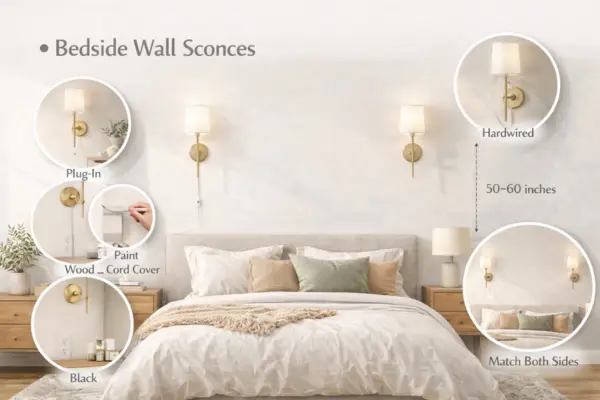
Why It Works
Sconces change the quality of light in a bedroom. Instead of light coming from below or from the centre of the room, it comes from the wall — at roughly reading height — and this creates a warmer, more directional glow that is both more flattering and more functional than overhead lighting.
They also free up your bedside table completely. No lamp base, no trailing cord, no shade taking up surface area. Just a clear, clutter-free surface for the things you actually need at night.
Best For
This idea is best for bedrooms where nightstands feel cluttered or too small. It is also perfect for anyone who does a lot of reading in bed, since the directed light from a sconce is far more practical for that purpose than a lamp further away. It suits all interior styles depending on the sconce design chosen — sleek metal arms for modern rooms, fabric-shaded fittings for traditional spaces, natural rattan for coastal or boho styles.
Styling Tips
- If you do not want to deal with electrical wiring, choose plug-in wall sconces. These are widely available, look excellent, and installation involves nothing more than a couple of fixings and a cord run to the nearest socket. Many come with a fabric cord that can be painted to match the wall.
- Mount sconces at roughly 150 to 160cm from the floor — this puts the light source at a good reading height when you are sitting up in bed, though the exact position depends on your mattress height and headboard.
- Match the finish of your sconces to your existing hardware where possible — door handles, mirror frames, curtain pole fittings. This creates cohesion without requiring any dramatic changes.
- Use bulbs with a warm colour temperature — around 2700K. This gives a relaxed, amber-toned light that feels restful and appropriate for a bedroom.
- For the neatest look, use a cord cover strip on the wall to hide any visible cable. These are inexpensive, paintable, and make a significant visual difference.
13. LED Accent Lighting
LED strip lighting is one of the most affordable ways to completely change the atmosphere of a bedroom. A strip of warm light placed behind a headboard, beneath a floating shelf, or along the top of a wardrobe creates a soft, ambient glow that makes the whole room feel cosier and more relaxed — especially in the evening.
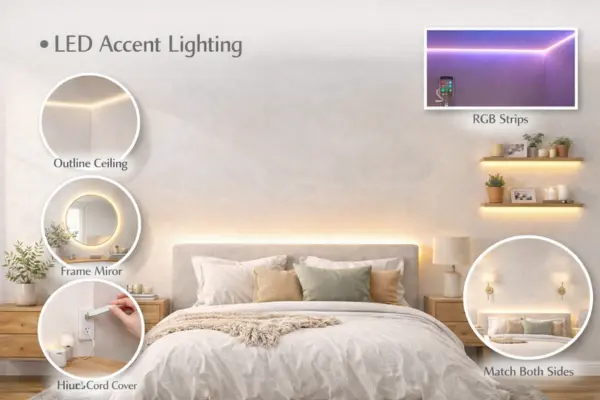
Why It Works
Accent lighting works by layering. Instead of one main light source that illuminates everything equally, you have light at different heights and positions that creates warmth and depth. The bedroom starts to feel like a retreat rather than just a room.
LED strips are also practical. They are cheap to run, last a very long time, and can be dimmed or colour-adjusted if you choose a smart version. Many people who install them wonder how they lived without them.
Best For
LED accent lighting is best for anyone who finds their bedroom feels too bright in the evenings — where overhead lighting makes it hard to wind down. It is a good option for renters since the strips attach with adhesive and remove without damage. It suits all bedroom styles, since the light itself is the feature — not the strip.
Styling Tips
- Always choose warm white LEDs for a bedroom — look for a colour temperature of 2700K to 3000K. Cooler or bluer whites feel clinical and make it harder to relax. They are right for a home office, not a bedroom.
- The goal is to see the glow, not the strip itself. Position the LED strip behind the headboard, under a shelf, or along the top edge of a wardrobe so the light is indirect. Direct exposure to the strip breaks the atmosphere immediately.
- Clean the surface thoroughly before applying. LED strips use adhesive backing and will not stick properly to dusty or damp surfaces.
- If you want to be able to adjust the brightness — and in a bedroom, you should — choose strips with a remote or smart app control. Being able to dim the lights from bed without getting up is a small luxury that makes a real difference.
- For a simple starting point, a single strip behind the headboard is enough. You will see the difference from the very first evening.
14. Textile Statement (Tapestry or Macramé)
Woven wall hangings, tapestries, and macramé pieces bring a softness to a bedroom that hard-surfaced art, paint, and mirrors simply cannot. The texture is tactile and warm. It changes how the room sounds as well as how it looks — fabric absorbs some sound, which makes a room feel quieter and more enclosed in the best possible way.
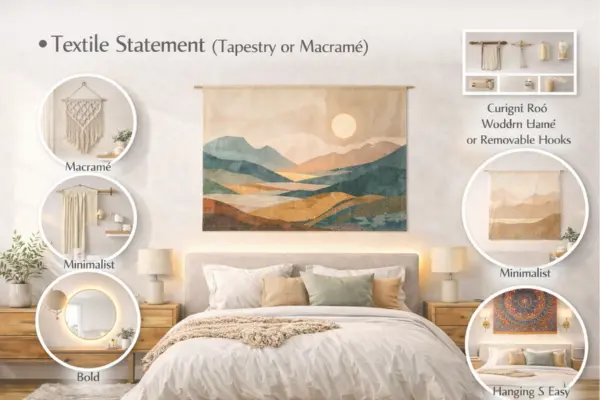
Why It Works
Textiles add a layer of warmth that painted and framed walls lack. They introduce organic texture, handmade quality, and the kind of imperfection that makes a room feel genuinely inhabited rather than showroom-perfect. A macramé hanging in natural cotton or a woven tapestry in earthy tones can do more for the atmosphere of a bedroom than a much more expensive piece of framed art.
They are also incredibly beginner-friendly. No complicated hanging hardware, no measuring for perfect symmetry — a single hook or a wooden dowel is often all you need.
Best For
Tapestries and macramé suit boho, coastal, natural, and Scandinavian-style bedrooms particularly well. They also work in more eclectic spaces where the goal is warmth and personality over strict visual order. This idea is great for renters since the pieces are lightweight and the hanging requirements are minimal. It also suits people who love handmade and craft aesthetics and want their bedroom to reflect that.
Styling Tips
- Choose a piece that is scaled appropriately for your wall. A large tapestry behind the bed can work in place of a headboard entirely — this works especially well with low platform beds. A smaller macramé piece suits a wall beside a window or above a nightstand.
- Hang on a wooden dowel threaded through the top of the piece, suspended from two nails or hooks. This distributes the weight evenly and prevents sagging in the middle.
- For calm, restful bedrooms, choose neutral or earthy tones — natural cotton, warm cream, terracotta, dusty sage. For a bolder statement, choose a tapestry with more pattern and contrast.
- Avoid placing textiles anywhere they might get consistently damp — beside an open window that lets in rain, for example. The material can develop mould if repeatedly wet and not allowed to dry properly.
15. Painted Accent Treatment (Colour Block, Arch, Geometrics)
Paint is the most accessible and affordable wall treatment that exists. A tin of paint and an afternoon is all it takes to completely change how a bedroom looks and feels. But a simple flat colour on the whole wall is just the beginning. Painted shapes — arches, colour blocks, geometric forms — turn a plain painted wall into something architectural and intentional.
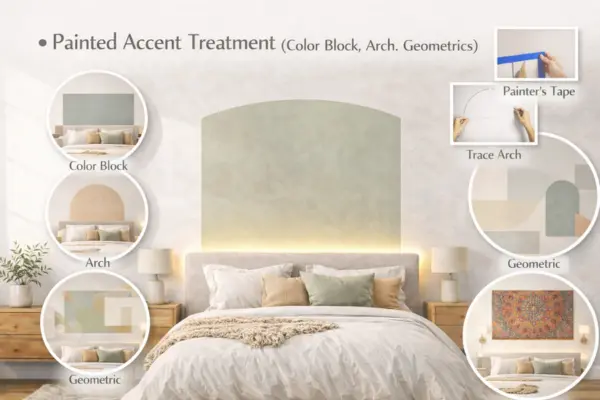
Why It Works
A painted shape gives the wall a focal point. It creates a contained visual area that the eye gravitates toward — usually framing the bed or a piece of furniture — which anchors the whole room and makes it feel more designed. The technique looks complex but is genuinely achievable for anyone with painter’s tape, a pencil, and a steady hand.
It is also completely reversible. If you change your mind, one coat of the original wall colour undoes everything. That makes it a zero-risk option even in rented accommodation, as long as you return the wall to its original colour when you leave.
Best For
This idea is best for people who want a high-impact change at very low cost. It is also ideal for renters who want to make a space feel personal without anything permanent. Painted arches behind the bed are the most popular choice right now and work in almost every bedroom style. Colour blocks and geometric forms suit more contemporary and graphic interiors.
Styling Tips
- For a painted arch, you do not need artistic skill. Tie a piece of string to a pencil, hold the other end at the centre point of where the arch top should be, and draw the curve. Use painter’s tape along the pencil line to create a clean edge, then paint within the shape.
- Choose a colour that is one or two shades deeper than your existing wall colour for a tonal effect, or choose a contrasting accent colour for something bolder. Muted, earthy tones — warm terracotta, dusty sage, soft clay — tend to work better in bedrooms than very saturated or bright colours.
- Remove painter’s tape while the paint is still slightly wet, not after it has dried fully. Pulling tape from dry paint risks lifting the wall paint underneath it. Peel slowly at a low angle for the cleanest edge.
- Apply two coats for full, even coverage. Let each coat dry completely before applying the next.
- If you are using a darker accent colour, apply a coat of primer first. This prevents the original wall colour from showing through and gives you a true, opaque finish.
Mistakes to Avoid
Knowing what to do is half the job. Knowing what not to do is equally important. These are the most common mistakes beginners make when decorating a bedroom wall — and exactly how to avoid them.
Hanging art too high. This is the single most common mistake in home decoration. Art that sits too high on the wall feels disconnected from the room. As a rule, the centre of any artwork should be at eye level — approximately 145 to 150cm from the floor. Above the bed, leave 15 to 20cm between the top of the headboard and the bottom of the frame.
Choosing art that is too small. A small print on a large wall looks timid and unfinished. If you are unsure whether a piece is big enough, it is probably not. Use the paper template trick — cut newspaper to the same size as the piece and tape it to the wall. If it looks too small on the paper, it will look too small in the frame.
Skipping the planning stage for gallery walls. Putting frames directly on the wall without arranging them on the floor first almost always leads to regret and extra holes. Always plan on the floor, photograph it, then transfer to the wall using paper templates.
Using the wrong wall fixings. Adhesive strips are brilliant for light objects. They are not suitable for heavy mirrors, large frames, or multiple-piece installations. Always check the weight limit on your fixing method and use proper wall anchors for anything heavy.
Overcrowding shelves. A cluttered shelf looks messy regardless of how beautiful each individual object is. Leave space. Breathe. Less is almost always more on a styled shelf.
Ignoring the rest of the room. Your wall decor should connect to the room around it — through colour, material, or tone. A bold piece of art that shares no colour with anything else in the room will always feel like it does not belong, no matter how beautiful it is on its own.
Choosing cold lighting. In a bedroom, lighting colour temperature matters enormously. Cool or bright-white LEDs and bulbs make a bedroom feel like an office. Always choose warm white — 2700K to 3000K — for any bedroom light source.
Conclusion
A blank bedroom wall is not a problem to solve. It is an opportunity to make the room feel more like yours. Whether you go with a single oversized print, a layered gallery wall, a painted arch, or a set of warm wall sconces, the result will be the same — a bedroom that feels finished, personal, and genuinely comfortable to be in.
You do not need to do everything at once. Pick one idea that excites you, take it slowly, and get it right. One change done well is worth far more than five changes done in a rush.
The bedroom is where you begin and end every day. It deserves a wall worth looking at.
FAQs
What is the easiest bedroom wall decor idea for a complete beginner? One oversized art print is the easiest starting point. One decision, one purchase, one hanging job. The impact is immediate and the process is almost impossible to get wrong. Choose a piece that includes at least one colour already in your room and hang the centre at eye level.
How do I decorate a bedroom wall without making holes? Adhesive hanging strips are strong enough for lightweight frames and smaller mirrors. Peel-and-stick murals and wall decals require no holes at all. Leaning a large mirror against the wall is another completely hole-free option. For heavier pieces, proper wall fixings are always safer.
What size art should I use above a bed? As a general guide, artwork above a bed should be roughly two thirds the width of the bed frame. For a standard double bed, this means art that is around 100 to 120cm wide. For a gallery wall, the overall arrangement should fill that same width rather than any single frame needing to do it alone.
Can I do any of these ideas if I am renting? Yes. Peel-and-stick murals, removable wall decals, adhesive hanging strips, plug-in wall sconces, LED strips with adhesive backing, floating shelves on renter-friendly brackets, tapestries on simple hooks, and leaned mirrors all work without causing wall damage. Just ensure you return the wall to its original condition before leaving.
How do I make a small bedroom wall look bigger? Use a large mirror — it reflects light and creates the illusion of more space. Keep wall decor simple rather than covering every inch. Vertical elements like tall art or wood slats draw the eye upward and make ceilings feel higher. Warm lighting adds depth without taking up any visual space.
How much should I spend on bedroom wall decor? You can achieve a beautiful result at almost any budget. A painted arch costs the price of a tin of paint. A peel-and-stick mural can be found for a modest amount. Digital prints bought online and printed locally are inexpensive. The most important investment is time — spending an afternoon planning properly will always give you a better result than rushing in and spending more to fix mistakes.
How do I know if a gallery wall will look good before I hang everything? Always lay your frames on the floor first and arrange them until you are happy. Take a photograph of the arrangement. Then cut paper templates in the same sizes and tape them to the wall. This gives you a completely accurate preview — with no holes in the wall — before you commit to anything.