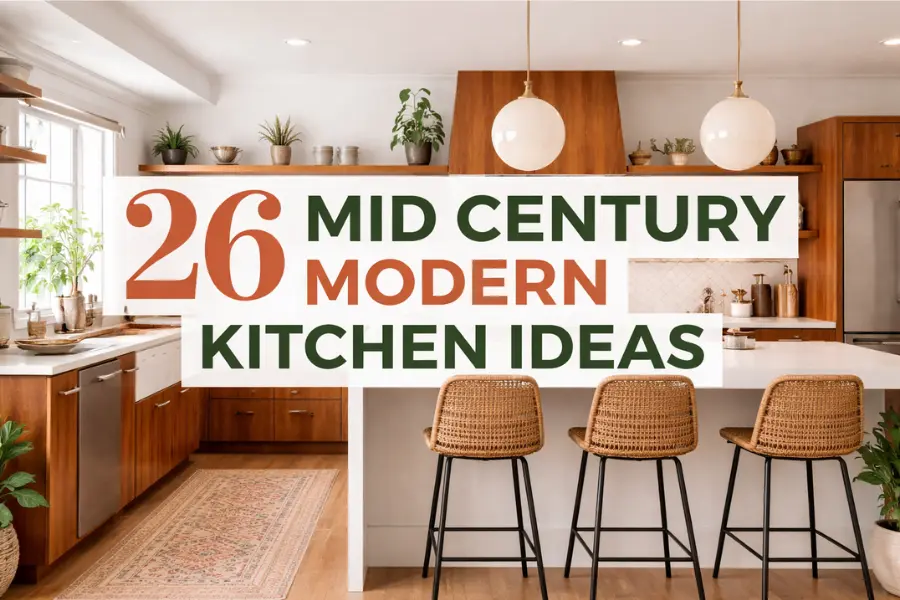
26 Mid-Century Modern Kitchen Ideas for Timeless Elegance
If you’ve ever looked at a kitchen photo and thought, “I don’t know what style that is, but I want it,” chances are it was mid-century modern. This style has been around since the 1940s and 50s, and honestly, it never gets old. That’s the whole point of it.
Mid-century modern kitchens are built on three things: clean lines, natural materials, and smart function. There’s no fussiness, no over-decorating, and no clutter for the sake of it. Everything has a purpose, and everything looks good doing it. Think warm wood cabinets, bold pops of retro color, open shelving, geometric tiles, and lighting that could pass as sculpture.
In this guide, I’m walking you through 24 of the best mid-century modern kitchen ideas, broken down so you can actually use them. Whether you’re starting from scratch or just want to refresh what you already have, there’s something here for you.
Table of Contents
26 Mid-Century Modern Kitchen Ideas
Here are the best ideas, you can follow:
1. Warm Walnut Cabinets
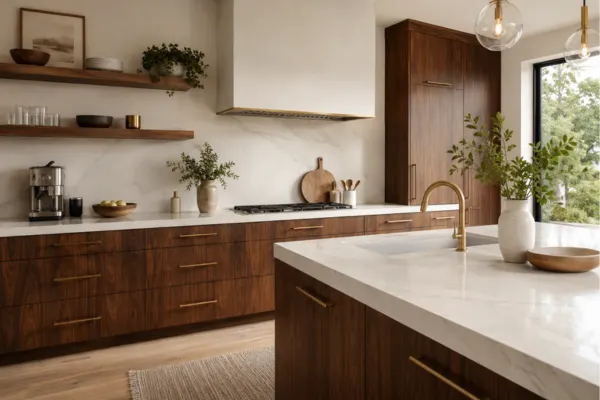
Walnut wood is one of those materials that does all the heavy lifting for you. The moment you bring it into a kitchen, the whole space shifts. It feels warmer, richer, and more intentional — like someone actually thought about what they were doing. Lower walnut cabinets are the go-to move in mid-century modern kitchens because they anchor the room without making it feel dark or heavy.
Why It Works
Walnut has a natural grain pattern that adds depth and texture without needing any extra effort. It sits right in that sweet spot between rustic and refined. Paired with the clean lines that mid-century style is known for, walnut cabinets give you that retro warmth without tipping into dated territory. It’s one of the few materials that feels equally at home in a 1950s-inspired kitchen and a completely modern one.
Best For
Walnut works beautifully in kitchens of any size, but it really shines in open-plan layouts where you have the floor space to let the wood breathe. If your kitchen gets good natural light, walnut will glow. It’s ideal for anyone who wants a kitchen that feels cozy and elevated at the same time, without going full farmhouse or all-white minimalist.
Styling Tips
The key to making walnut work is contrast. Go lighter on the countertops — white quartz or light marble keeps things bright and balanced. For hardware, thin brass pulls or matte black handles are your best friends here. Keep the upper cabinets simple, either in white or a soft cream, so the walnut on the lowers gets to be the star. Avoid matching every element in wood tones or it’ll start to feel like a log cabin.
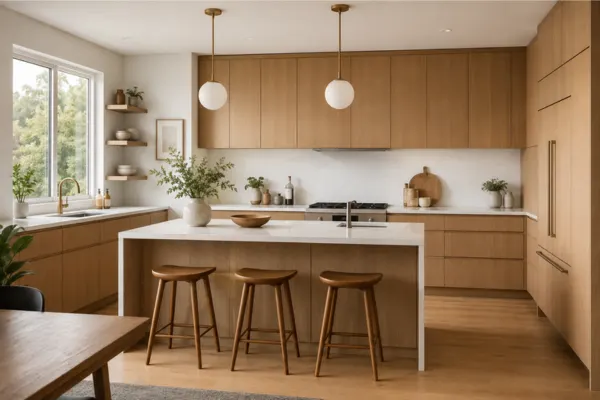
2. Flat-Front Cabinet Doors
Flat-front cabinets are the unsung heroes of mid-century modern design. No raised panels, no decorative trim, no ornate detailing — just clean, flat surfaces that let the rest of the kitchen speak. It sounds simple because it is, and that’s exactly why it works so well.
Why It Works
The whole philosophy of mid-century modern is “less is more, but make it intentional.” Flat-front doors are the physical embodiment of that. They keep the eye moving smoothly across the kitchen without anything catching or interrupting the flow. In a style that’s all about clean geometry and smart design, flat fronts are non-negotiable.
Best For
This is a great choice for smaller kitchens where you want to avoid visual clutter. Flat-front doors make the space feel bigger and more open because there’s nothing breaking up the surface. They also work perfectly for anyone who prefers a contemporary spin on the retro look — you get the mid-century vibe without going full vintage.
Styling Tips
If you’re going with flat-front doors, lean into the minimalism. Hide your appliances where you can, use sleek integrated handles or a simple bar pull, and choose a cabinet color that holds its own — pale wood, muted sage, or a warm off-white all look great. Avoid busy countertops or loud backsplash tiles if your cabinets are flat-front, or the simplicity gets lost.
3. Open Shelving
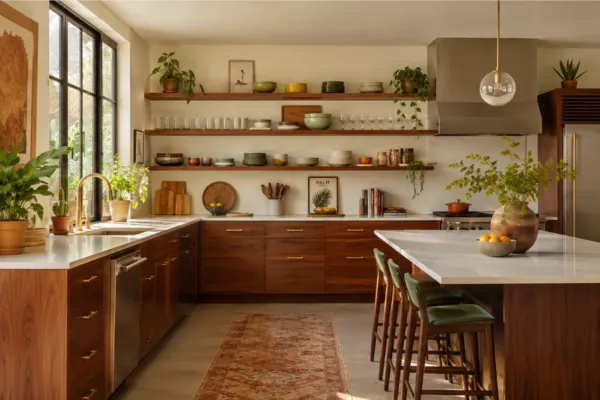
Open shelving is one of those ideas that feels a little scary at first — everything on display, no hiding anything — but when you do it right, it completely transforms a kitchen. Mid-century modern homes have always embraced the idea that everyday objects can be beautiful, and open shelving is the proof.
Why It Works
Open shelves make a kitchen feel bigger and more relaxed. There’s an airiness to them that closed cabinets just can’t replicate. They also force you to be intentional about what you keep out, which means your kitchen naturally stays more curated and organized. Plus, it’s a great way to show off beautiful ceramics, glassware, or handmade pottery that would otherwise be hidden behind a door.
Best For
Open shelving works best in larger kitchens where you have enough storage elsewhere to handle the practical stuff. It also suits people who genuinely enjoy organizing and styling their space. If you love decor and have a collection of beautiful dishes or vintage finds you want to display, this is your moment.
Styling Tips
The trick with open shelving is to treat each shelf like a little vignette. Group similar items together — stack plates neatly, line up glasses in a row, tuck a small plant on the end. Use a mix of functional and decorative items so it doesn’t look too precious. Avoid overcrowding the shelves, and resist the urge to store everything you own up there. A little breathing room goes a long way.
4. Retro Color Splash
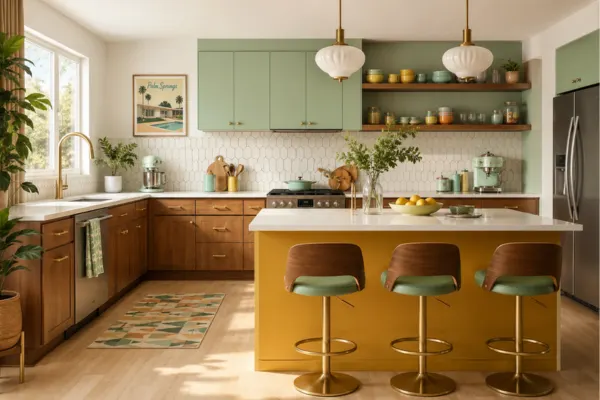
One of the things that makes mid-century modern kitchens so memorable is the color. We’re not talking about subtle, barely-there color — we’re talking mint green cabinets, mustard yellow accents, warm terracotta tones. The kind of color that makes you feel something when you walk in.
Why It Works
Color is how mid-century modern kitchens break out of the “too serious” trap that minimalist design can sometimes fall into. A pop of retro color gives the space personality and energy without messing with the clean lines and functional design underneath. It’s the difference between a kitchen that looks like a showroom and one that actually feels like someone lives there.
Best For
This approach is perfect for anyone who finds all-neutral kitchens a little too safe or sterile. If you want your kitchen to have a mood — cheerful, bold, playful — then a retro color splash is the move. It also works really well if you’re renting and can’t do a full renovation, since you can get the look with appliances, accessories, and textiles rather than committing to colored cabinets permanently.
Styling Tips
The golden rule here is balance. One or two bold colors, max. If you go mustard on the lower cabinets, keep the uppers white and the countertops neutral. Let the color be the statement, and then support it with simple surroundings. Retro-inspired small appliances — a pastel stand mixer, a colored kettle — are an easy way to layer in color without any renovation work.
5. Terrazzo Countertops
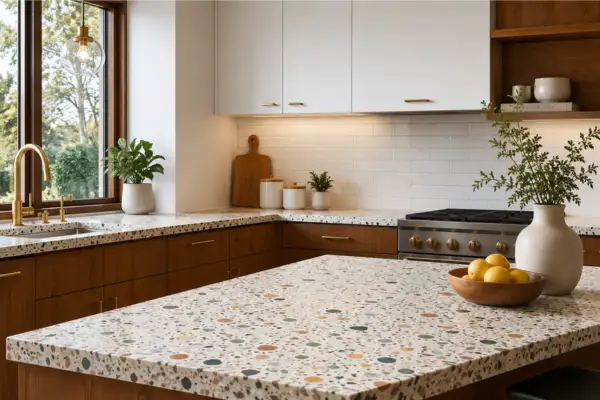
Terrazzo has made a serious comeback, and for good reason. This material — made from chips of marble, quartz, granite, or glass set in a smooth base — has been around since the 15th century, but it hits differently in a mid-century modern kitchen. It’s got pattern, it’s got texture, and it’s incredibly durable.
Why It Works
Terrazzo brings visual interest to a kitchen in a way that’s much more subtle and layered than a bold tile or painted wall. The speckled surface catches the light differently throughout the day, and it plays nicely with both warm wood tones and cooler neutral palettes. It’s a material that looks effortlessly cool without trying too hard, which is very on-brand for mid-century style.
Best For
Terrazzo is ideal for homeowners who want something that stands out from the usual marble or quartz options but don’t want to go too far. It’s also a great pick if you’re working with a neutral color scheme and want one material to carry the personality of the space. Practically speaking, it’s also super durable and easy to clean.
Styling Tips
Because terrazzo already has a lot going on visually, keep everything around it simple. Flat-front cabinets, minimal hardware, and clean lines let the countertop shine. Avoid pairing it with busy backsplash tiles or heavily grained wood — you want the terrazzo to be the interesting element in the room, not competing with everything else for attention.
6. Integrated Appliances
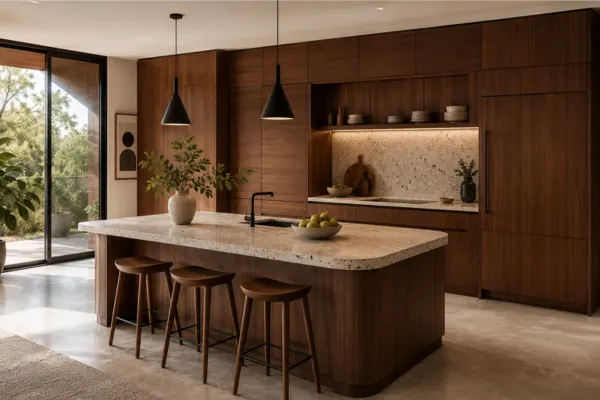
In a mid-century modern kitchen, the goal is for everything to feel intentional and seamless. Integrated appliances — where your fridge, dishwasher, or oven is hidden behind cabinetry panels — are one of the most effective ways to achieve that polished, put-together look.
Why It Works
When appliances are visible, they become visual interruptions. The eye catches on them and the flow of the kitchen gets broken. When they’re hidden behind cabinet panels that match the rest of the kitchen, everything reads as one cohesive design. It’s a small thing that makes a surprisingly big difference in how sophisticated a kitchen looks.
Best For
Integrated appliances work best in larger kitchens where the budget allows for custom cabinetry. They’re ideal for anyone who wants a truly seamless, high-end look — the kind of kitchen where guests walk in and aren’t quite sure where everything is because it all blends together so beautifully.
Styling Tips
If you’re going the integrated route, commit to it fully. Hiding just the fridge but leaving a bulky microwave on the counter will undercut the whole effect. Plan your cabinetry from the start with integration in mind, and work with a kitchen designer or cabinet maker who has experience with this approach. Stick to clean, flat-front cabinet doors to maintain the visual harmony.
7. Sculptural Lighting
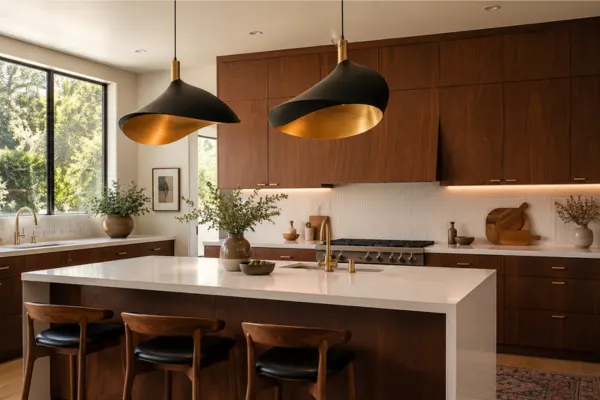
Mid-century modern designers believed that even everyday objects should be beautiful. Lighting is where this philosophy really gets to shine. Pendant lights with organic shapes, bold geometric silhouettes, or unexpected materials are a signature element of the style — and they’re one of the easiest ways to add serious impact to a kitchen.
Why It Works
Good lighting does two things in a mid-century modern kitchen: it provides the illumination you actually need, and it adds a sculptural element that draws the eye upward and creates a focal point. A well-chosen pendant or cluster of pendants over a kitchen island can be the single most transformative change you make to a space.
Best For
Anyone who wants to add a visual statement to their kitchen without doing major renovation work. Replacing existing pendant lights is a relatively simple swap that can completely change the personality of a space. It’s especially impactful over kitchen islands, breakfast bars, or dining areas within the kitchen.
Styling Tips
Go for shapes that feel intentional — globe pendants in brass or smoked glass, Sputnik-style fixtures, or organic ceramic shades all hit the mid-century mark. Brass and matte black are the finishes that work best with this style. Hang pendants at a height where they create intimacy without blocking sightlines, and consider grouping two or three together for a bigger visual impact.
8. Wooden Ceiling Beams
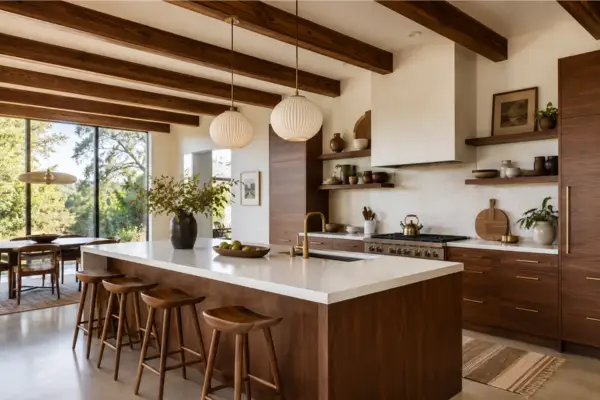
Exposed wooden beams on the ceiling are a brilliant way to add warmth and texture to a mid-century modern kitchen without changing a single cabinet or countertop. They bring in an organic, natural element that softens the clean lines of the style and makes the whole space feel grounded and lived-in.
Why It Works
Mid-century modern design has always been rooted in a love of natural materials. Wood, stone, leather — these are the textures that give the style soul. Ceiling beams bring that natural warmth to an often-overlooked part of the room. They also add architectural interest and visual height, making a kitchen feel more bespoke and less like a flat-pack showroom.
Best For
Wooden ceiling beams work best in kitchens with higher ceilings where the beams have room to breathe without making the space feel cramped. They’re especially effective in open-plan kitchens or spaces that connect to living and dining areas, where the beams can carry through and create a unified look across the whole room.
Styling Tips
Match the beam finish to other wood elements in the kitchen — if you have walnut cabinets, look for a similar tone in the beams. Keep the rest of the ceiling white or light to create contrast. Don’t over-style the kitchen when beams are present; let them do the heavy lifting and keep the surrounding elements simple and clean.
9. Geometric Backsplash Tile
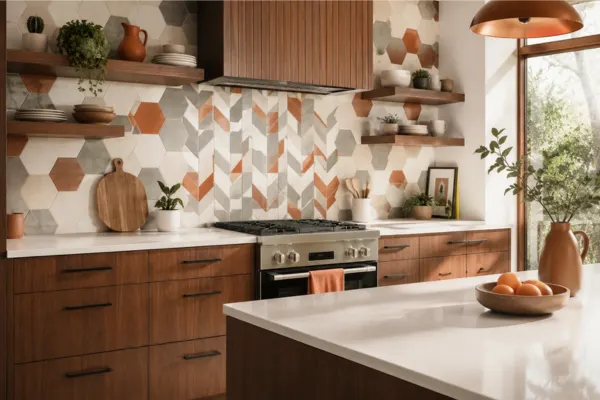
A geometric backsplash is one of the most satisfying ways to bring pattern into a mid-century modern kitchen. Hexagon tiles, chevron patterns, elongated subway tiles laid in a herringbone stack — any of these can add serious visual interest to the space between your countertop and upper cabinets.
Why It Works
Pattern is a core part of mid-century modern design — it shows up in upholstery, flooring, wallpaper, and tile. A geometric backsplash brings that design sensibility into the kitchen in a way that’s both practical (easy to clean, durable) and beautiful. It creates a defined focal point behind the range or sink without requiring any structural changes.
Best For
This is a great move for anyone who wants to add personality to a neutral kitchen or break up an all-wood palette with something graphic and eye-catching. It also works well as the one bold design choice in a more restrained kitchen — everything else can stay calm while the backsplash does the work.
Styling Tips
Keep the surrounding elements neutral when you’re working with a patterned backsplash. Simple cabinets, plain countertops, and minimal hardware let the tile take center stage. Choose tile colors that pull from the rest of the palette — if your cabinets are walnut and your countertops are white, a warm-toned geometric tile in cream or terracotta will tie everything together beautifully.
10. Two-Tone Cabinets
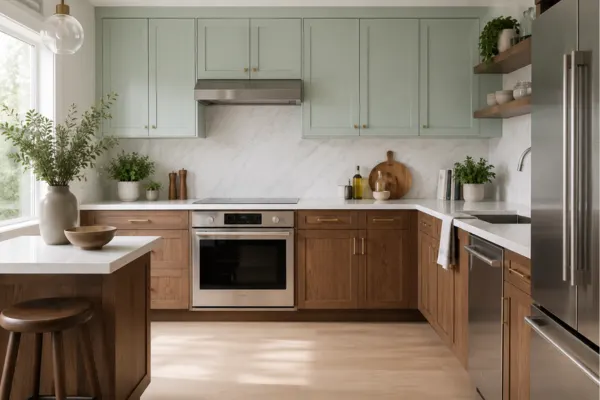
Two-tone cabinetry is a classic mid-century trick that adds depth and visual interest to a kitchen without making it feel chaotic. The most common approach is darker lowers and lighter uppers — think rich walnut on the bottom and crisp white or soft sage on top — but the combination possibilities are pretty endless.
Why It Works
Using two different cabinet colors creates contrast and definition in the kitchen. It separates the upper and lower halves of the room visually, which makes the space feel more dynamic and considered. It’s also a great way to bring in a second color — maybe that retro mustard or forest green you love — without committing to it everywhere.
Best For
Two-tone cabinetry works in almost any kitchen size, but it’s especially effective in medium to large kitchens where you have enough visual real estate for the two tones to both register. It’s a great choice for anyone who feels like their kitchen looks a little flat or one-dimensional and wants more visual complexity without a full redesign.
Styling Tips
The most important thing is making sure the two tones genuinely complement each other rather than fighting. Try pairing warm wood lowers with white or cream uppers, or muted green lowers with natural white oak uppers. Tie the two halves together with consistent hardware throughout — the same pull design in the same finish on both upper and lower cabinets makes everything feel cohesive.
11. Minimal Upper Cabinets
Here’s a design move that feels counterintuitive but works incredibly well: what if you just… didn’t have as many upper cabinets? Reducing or eliminating upper cabinetry in favor of open shelving, wall art, or simply painted wall space is a very mid-century approach that immediately makes a kitchen feel more modern and less cluttered.
Why It Works
Upper cabinets, when they cover every inch of wall space, can make a kitchen feel boxy and heavy. Taking some of them away opens up the walls and creates breathing room that makes the space feel larger and more intentional. It also pushes you to be more organized with what you store, which aligns perfectly with the mid-century philosophy of keeping only what serves you.
Best For
This works particularly well in smaller kitchens where traditional upper cabinets make the space feel cramped. It’s also ideal for people who are minimalist by nature and don’t have a huge amount of kitchenware to store. If you’re someone who tends to accumulate stuff, this approach will require some editing — but the result is worth it.
Styling Tips
Replace removed upper cabinets with floating shelves in a matching wood tone for a connected look. Use the wall space thoughtfully — a single piece of artwork, a vintage clock, or a small collection of plants can all work beautifully. Make sure your lower cabinets and pantry storage are well-organized to compensate for the reduced upper storage, and use drawer organizers and pull-outs to maximize every inch.
12. Wood and Brass Pairing
If you want to understand mid-century modern in two materials, wood and brass is your answer. This combination shows up again and again in the style — in furniture, in fixtures, in hardware — and for good reason. Warm wood brings nature and texture; brass brings a touch of quiet luxury. Together, they’re effortlessly elegant.
Why It Works
Wood and brass have a natural affinity for each other because they’re both warm in tone. There’s no clash, no competition — they just work together. Brass also has a slightly retro quality that feels perfectly at home in mid-century design, but it’s also sophisticated enough to feel very current. It’s the combination that makes a kitchen feel like it was designed rather than assembled.
Best For
This pairing works especially well in kitchens that already have wood elements — cabinets, flooring, shelving — and need a metal finish to pull everything together. It’s ideal for anyone who wants warmth and elegance without going precious or overly formal. Works beautifully with walnut, oak, and lighter maple tones.
Styling Tips
Use brass as an accent, not a dominant element. Cabinet pulls, a faucet, pendant light fixtures, or a pot rack are all great places to bring in brass without overdoing it. If you go brass hardware on the cabinets, you don’t necessarily need a brass faucet too — pick one or two places where it appears and let those moments count. Matte or brushed brass looks more current than polished brass, and it’s more forgiving to maintain.
13. Floating Breakfast Bar
A floating breakfast bar is one of those additions that immediately makes a kitchen feel more functional and more stylish at the same time. It provides a casual dining spot, an extra prep surface, and a visual anchor — all without taking up the square footage that a full kitchen island would require.
Why It Works
Mid-century modern kitchens are as much about how a space is used as how it looks. A floating breakfast bar adds a social element to the kitchen — somewhere to sit with a coffee while someone cooks, or to have a quick meal without setting a formal table. It’s also a design element in its own right, especially when paired with great stools and kept visually clean and simple.
Best For
This is a brilliant solution for smaller kitchens where a full island isn’t possible, or for open-plan spaces where you want to create a subtle division between the kitchen and living areas without putting up a wall. It works for anyone who wants a casual dining option or an extra surface for food prep.
Styling Tips
Keep the bar itself simple — a clean slab of wood, stone, or even a painted MDF board with a good finish. The magic is in the stools you choose. Go for slender-legged stools in metal or wood with a low-profile silhouette — that’s the mid-century signature. Avoid bulky bar stools with thick bases; they make the floating bar feel heavy instead of light and airy.
14. Earth-Toned Walls
Earth tones are having a major moment in kitchen design, and they’ve always been part of the mid-century modern palette. Soft clay, muted terracotta, warm sage, dusty olive — these are colors that feel grounded and calm, and they pair beautifully with the natural materials and wood tones that define the style.
Why It Works
Earth tones create a sense of warmth and ease in a kitchen without the visual noise of a bold, saturated color. They feel intentional and sophisticated, and they work harmoniously with wood, stone, ceramic, and brass — all the materials that mid-century modern kitchens rely on. An earth-toned wall also makes the wood elements in a kitchen look even richer and more vibrant by comparison.
Best For
Earth tones work in kitchens of all sizes, but they’re especially impactful in larger spaces where a full wall of color reads as dramatic and considered. They’re great for anyone who wants to move away from the all-white kitchen trend but isn’t ready to commit to a bold, saturated color.
Styling Tips
Test your chosen wall color against your cabinet finish, countertop material, and flooring before committing. A terracotta wall with warm walnut cabinets and a marble countertop is a stunning combination; that same terracotta with cool-toned gray cabinets might not work as well. Keep your tiles and textiles neutral to let the wall color lead, and add warmth through wooden accessories and simple greenery.
15. Sleek Pull Hardware
Cabinet hardware is one of those details that’s easy to overlook but impossible to ignore once you know what to look for. In a mid-century modern kitchen, the hardware is almost always linear and minimalist — long, slender bar pulls that run horizontally across cabinet doors and drawers. It’s a small choice that has a massive impact on the overall look.
Why It Works
Pull hardware in a mid-century modern kitchen serves the same purpose as the flat-front cabinet doors it sits on — it reinforces the clean, horizontal lines of the design and keeps everything feeling streamlined and intentional. The right hardware makes a kitchen look finished and considered; the wrong hardware (think ornate knobs or decorative pulls with curves and flourishes) completely undercuts the style.
Best For
This is a universal recommendation for anyone doing or updating a mid-century modern kitchen. Whether you have walnut cabinets or white flat-fronts, the right hardware makes the look complete. It’s also one of the most cost-effective updates you can make to an existing kitchen — swapping out old knobs for sleek bar pulls can modernize a space dramatically.
Styling Tips
Stick to matte black, brushed brass, or satin nickel for the finish. Matte black is the sharpest and most graphic; brass is warmer and more retro; nickel is the most neutral option. Make sure the pulls are proportionate to your cabinet size — longer pulls on bigger doors, shorter pulls on smaller ones. Consistency matters: use the same pull design throughout the entire kitchen.
16. Terrazzo Floor Tile
Terrazzo on the floor is a bold, confident choice that immediately sets a mid-century modern kitchen apart. It’s the kind of flooring that makes people stop and say, “okay, this kitchen is doing something different.” And it delivers on both the aesthetic and practical fronts.
Why It Works
Terrazzo flooring brings pattern and texture underfoot in a way that feels vintage but not dated. The speckled surface has a visual complexity that ties together different tones in the kitchen — it can pick up on the warm chips in your stone countertop, echo the green in your cabinet color, or simply add a layer of interest to an otherwise neutral palette. And because terrazzo is incredibly durable and easy to clean, it’s as practical as it is beautiful.
Best For
Terrazzo floors work best in kitchens where the rest of the design is relatively restrained. If your cabinets are simple, your countertops are neutral, and your walls are calm, the terrazzo floor can be the one dramatic element that carries the whole room. It’s also a great choice for high-traffic kitchens because it genuinely stands up to daily wear and tear.
Styling Tips
Choose a terrazzo colorway that connects to at least one other element in the kitchen — a chip color that echoes your cabinet tone, or a base color that matches your wall paint. Keep the surrounding design simple and minimal so the floor has room to express itself. Avoid adding too many other patterned elements (busy backsplash + terrazzo floor = visual chaos).
17. Vaulted Window Light
Natural light is one of the most powerful design tools available, and mid-century modern architecture has always understood this. Large windows, clerestory windows, and skylights are all hallmarks of the style — they connect the interior to the outside world and fill the kitchen with the kind of light that makes everything look better.
Why It Works
Natural light doesn’t just illuminate a space — it changes how every material and color in the room reads. Walnut cabinets look richer, white countertops look crisper, and plants look more vibrant in natural light. In a mid-century modern kitchen, where materials and finishes are doing a lot of the work, good light is essential for letting them perform at their best.
Best For
This is most achievable if you’re doing a renovation or building new, since adding or enlarging windows is a structural change. But if your kitchen already has opportunities for more light — a window that could be made bigger, a wall that could take a skylight — it’s worth considering. Anyone with an east or south-facing kitchen especially stands to benefit.
Styling Tips
Keep window treatments minimal — sheer linen panels or simple roller blinds in a neutral tone let the light in while giving you privacy when needed. Avoid heavy drapes or ornate valances that would work against the clean aesthetic. If you’re adding a skylight, position it over the primary prep or cooking area for maximum functional benefit.
18. Bold Accent Wall
An accent wall in a mid-century modern kitchen is a design move that delivers maximum impact with minimum effort. One wall in a deep, saturated color — forest green, navy blue, mustard yellow, or burnt orange — creates instant drama and pulls the whole kitchen into focus.
Why It Works
A bold accent wall does something clever: it gives the eye somewhere to land. Rather than scanning a kitchen that feels a bit flat or even across all four walls, a single bold wall creates depth and hierarchy. It makes the space feel designed rather than defaulted. And in a style where restraint is the rule, one bold wall is exactly enough.
Best For
Accent walls work beautifully in larger kitchens where you have a wall that can be seen from a distance. They’re also great in open-plan spaces where the kitchen wall is visible from the living or dining area — the bold color becomes a feature that ties the whole open space together. This is also a great option for renters who can paint and repaint freely.
Styling Tips
Choose a wall color that references the overall palette of the kitchen. If your cabinets are walnut and your hardware is brass, a deep olive green or terracotta on the accent wall will feel cohesive and considered. Keep the remaining three walls neutral — white, cream, or a very light version of the accent color. Don’t add too many other bold elements when you have an accent wall; let the color do the talking.
19. Walnut Flooring
Walnut flooring in a kitchen is a commitment, and it pays off. The rich, dark tones of walnut underfoot create a sense of elegance and warmth that’s very hard to achieve with tile or laminate. It’s one of the defining materials of mid-century modern interiors, and in a kitchen, it grounds the whole space beautifully.
Why It Works
Walnut has a natural richness and depth that makes a kitchen feel more luxurious and more considered. The grain pattern adds texture without pattern, which means it adds visual interest without competing with other design elements. It also ages beautifully — real walnut develops a patina over time that only adds to its character.
Best For
Walnut flooring works best in kitchens that receive moderate foot traffic and are not prone to flooding or excessive moisture. It’s ideal for anyone who wants to unify the kitchen with adjacent living spaces — running the same walnut flooring through an open-plan kitchen and living area creates a seamless, sophisticated look. Best suited to people who are prepared to maintain and occasionally refinish their floors.
Styling Tips
When you have walnut floors, keep the rest of the kitchen lighter to avoid the space feeling dark. White or cream upper cabinets, light countertops, and plenty of natural light are the balance the walnut needs. Avoid too many other dark wood elements — the flooring is enough. A simple area rug in a warm neutral or geometric print can add softness and define the kitchen zone within an open-plan space.
20. Decorative Vintage Pieces
Mid-century modern is one of those rare styles where adding a few well-chosen vintage pieces doesn’t just work — it actually completes the look. A retro wall clock, a vintage enamel breadbox, a classic stand mixer in an old-school color, a ceramic crock — these little touches are what separate a kitchen that looks mid-century modern from one that feels it.
Why It Works
The mid-century era produced some of the most beautifully designed everyday objects in history. Bringing a few of those pieces into your kitchen creates an authentic connection to the style and adds personality that no new product can quite replicate. Vintage pieces also tell a story, and a kitchen with a story feels more like a home than a showroom.
Best For
This approach works for anyone who loves the hunt of finding vintage pieces and enjoys layering their space with objects that have history and meaning. It’s especially effective in kitchens that are otherwise quite minimal or neutral, where a few standout vintage items can do the work of warming and personalizing the whole space.
Styling Tips
The key word here is restraint. Three to five intentional vintage pieces are enough — a clock, a small appliance, a ceramic bowl or vase. More than that and you tip from curated into cluttered. Choose pieces that are roughly from the same era and in a similar color family. Display them where they’re useful (a vintage clock on the wall, a ceramic crock for utensils near the stove) so they’re part of the kitchen’s daily life, not just decoration.
21. Soft Green Accents
Soft green is one of those colors that just belongs in a mid-century modern kitchen. Whether it shows up on cabinet doors, in a backsplash tile, in ceramic accessories, or simply on the walls, this calm, nature-inspired tone brings a quiet energy to the space that works beautifully with wood, brass, and stone.
Why It Works
Green sits naturally at the intersection of vintage and fresh. It was everywhere in mid-century color palettes — avocado green appliances, sage green cabinetry, mint green tiles — but in its softer, more muted contemporary form, it feels both nostalgic and completely current. It also has a natural affinity with plants, which means adding greenery to the kitchen feels effortless when green is already part of the palette.
Best For
Soft green works in kitchens of all sizes and suits a wide range of design personalities — from the person who wants just a hint of color in an otherwise neutral kitchen to the person ready to commit to full green cabinetry. It pairs especially well with warm woods and natural stone.
Styling Tips
The softer and more muted your green, the more versatile it becomes. Sage, eucalyptus, and dusty olive are more flexible than bright or yellow-leaning greens, which can feel more period-specific. Pair soft green with warm white walls, natural wood open shelving, and brass or copper hardware for a look that feels quietly stunning without being loud about it.
22. Statement Bar Stools
Bar stools are one of those elements that people often choose last, almost as an afterthought. But in a mid-century modern kitchen, the right bar stool is part of the design. The silhouette, the leg style, the seat material — all of it contributes to the overall feel of the space, and getting it right makes a real difference.
Why It Works
Mid-century modern furniture is defined by its legs — those slender, tapered wooden or metal legs that lift everything off the ground and give it a light, almost hovering quality. Bar stools that carry this quality bring that same energy into the kitchen. They add visual interest at counter height and complement the clean lines of the cabinetry and island.
Best For
Statement bar stools are most impactful if you have a kitchen island or floating breakfast bar that’s visible from the main living space. If your stools are going to be seen from a distance, their silhouette really matters. This is also a great opportunity to bring in an accent color — a bold seat cushion in mustard, teal, or rust can tie together multiple elements of the kitchen palette.
Styling Tips
Look for stools with slender legs — either tapered wood or thin metal. Avoid chunky pedestal bases or overly cushioned seats, which read more contemporary or farmhouse than mid-century. A seat with a subtle curve or a molded plastic shell in a bold color is very on-point for the style. Make sure the stool height matches your counter height — counter stools are typically 24 to 26 inches, bar stools are 28 to 30 inches.
23. Natural Stone Countertops
Natural stone countertops have been a kitchen staple for a long time, but in a mid-century modern kitchen, they serve a very specific purpose: they bring in the organic texture and subtle variation that keeps the clean-lined aesthetic from feeling too cold or clinical. Marble, quartzite, and honed granite are all excellent choices.
Why It Works
Natural stone has a quiet beauty that manufactured surfaces struggle to replicate. The veining in marble, the mineral flecks in granite, the subtle variation in quartzite — these all add depth and character to a kitchen without adding visual noise. In a style that values natural materials and honest craftsmanship, stone countertops are a perfect fit.
Best For
Natural stone is ideal for homeowners who want a countertop material that looks better with age and develops character over time. It’s also great for anyone who bakes or does a lot of cooking, since stone surfaces stay cool and are excellent for working with pastry dough. Keep in mind that marble in particular requires sealing and some care — it’s not the most low-maintenance option.
Styling Tips
For a mid-century modern kitchen, go for a honed (matte) finish rather than a high-gloss polish — it feels more natural and less formal. Choose a stone with subtle, not dramatic, veining so it doesn’t overwhelm the space. Pair light stone countertops with darker wood cabinets, and darker stone with lighter cabinetry, to maintain that all-important balance.
24. Hidden Storage Solutions
A mid-century modern kitchen should look effortlessly organized, and hidden storage solutions are how you actually achieve that in real life. Pull-out spice racks, deep drawer organizers, cabinet inserts for pots and lids, and appliance garages are all tools that keep the kitchen functioning without letting the chaos show.
Why It Works
The whole design philosophy behind mid-century modern is that form and function exist in harmony. The kitchen should look beautiful and work beautifully at the same time. Hidden storage lets you maintain the clean, clutter-free surfaces that define the style without sacrificing the practical storage you need. It’s design that works for real life, not just for photos.
Best For
This is relevant for everyone, but it’s especially valuable for smaller kitchens where every inch matters. Hidden storage solutions also suit anyone who likes to cook seriously — lots of equipment, lots of ingredients — but doesn’t want the kitchen to look like a professional kitchen with things everywhere.
Styling Tips
Plan your storage from the inside out. Before you choose cabinet sizes and configurations, think through everything you need to store and how you want to access it. Pull-out drawers are more functional than deep cabinets where things get lost at the back. Drawer organizers and dividers keep everything in its place. And an appliance garage — a cabinet with a lift-up or roll-up door at counter level — is the best way to keep everyday appliances accessible without leaving them out on the counter.
Mistakes to Avoid
Even with the best intentions, mid-century modern kitchens can go sideways when a few common errors creep in. Here’s what to watch out for:
Overcrowding with color is the most common mistake. The style does embrace bold color, but there’s a limit. Two or three colors in the whole kitchen is enough — more than that and everything starts to compete. Pick your palette and commit to it.
Clashing materials is another trap. Mid-century modern actually combines quite a few different textures — wood, stone, metal, ceramic — but they need to be in the same tonal family. Warm woods with warm stone and warm brass, for example. Mixing warm and cool tones indiscriminately creates a disconnected, unfinished feel.
Sacrificing function for aesthetics will make you resent your kitchen. Open shelving looks beautiful when it’s styled for a photo shoot; it needs to work for a Tuesday morning when you’re late and the cereal box is in the way. Design for how you actually live, not how you want your kitchen to look on Pinterest.
Going too retro tips the balance from “mid-century inspired” into “time capsule.” A few vintage pieces, some retro color, and the right furniture silhouettes are all you need. If every element is aggressively vintage, it starts to feel like a costume rather than a home.
Underestimating lighting is a mistake that affects everything else. Good lighting in a kitchen means task lighting where you work, ambient lighting that creates atmosphere, and ideally natural light that changes throughout the day. Don’t get so focused on the design elements that you neglect to light them properly.
Conclusion
Mid-century modern kitchens are timeless for a reason. They’re rooted in ideas that never go out of style: use good materials, keep things functional, don’t overcomplicate it, and let the design breathe. Whether you take on one idea from this list or twelve, the underlying principle is the same — be intentional.
You don’t need a massive budget or a full renovation to get the look. Sometimes it’s the walnut floating shelf replacing a bulky upper cabinet. Sometimes it’s the right bar stool, or a pendant light that changes the whole mood of the room. Mid-century modern is a style that rewards thoughtfulness over spending.
Start with what feels most natural to you, layer in the other elements over time, and don’t rush it. The best version of this style in your home is the one that fits how you actually live — warm, functional, and quietly beautiful.
FAQs
What is the most important element of a mid-century modern kitchen?
The single most important element is clean lines — in the cabinetry, the hardware, the surfaces, and the overall layout. Everything else (the wood tones, the color pops, the lighting) builds on top of that foundation. Get the lines right and the rest of the style falls into place naturally.
Can mid-century modern kitchens work in small spaces?
Absolutely, and in some ways they work even better in small kitchens. The style’s emphasis on minimalism, integrated appliances, and efficient use of space means you’re not fighting against the limitations of a small room — you’re designing with them in mind. Flat-front cabinets, minimal upper cabinetry, and light color palettes all make a small kitchen feel larger and more intentional.
How do I add retro elements without the kitchen looking dated?
The key is mixing retro-inspired elements with clean, contemporary design. One vintage piece, one retro color, one geometric tile pattern — any one of these gives you the nostalgic nod you’re looking for without tipping the whole kitchen into the past. The surrounding design should always feel current and grounded, so the retro elements read as a choice rather than a leftover.
What colors work best in a mid-century modern kitchen?
The core palette is warm neutrals — whites, creams, warm grays, and natural wood tones. On top of that, mid-century modern loves accent colors in earthy or retro tones: mustard yellow, sage green, terracotta, deep olive, and warm teal. Avoid overly cool or sterile colors like icy blue or cool gray, which tend to fight against the warm, natural materials that define the style.
Is mid-century modern expensive to achieve?
It doesn’t have to be. The style is actually very adaptable to different budgets because its core elements — clean lines, natural materials, minimal decoration — aren’t inherently expensive. Flat-front cabinet doors are often cheaper than decorative ones. Open shelving costs less than upper cabinets. A few well-chosen vintage pieces from a thrift store can do more for the look than a whole set of new accessories. Focus your budget on the things that matter most — quality cabinetry, good lighting, and one or two statement materials — and be more economical everywhere else.